POSITION GUIDE · WINGER
Winger in Soccer: The Position, Left vs Right Wing, and How to Play It
What a winger does, how left and right wing differ, the types of winger, and the decisions that make a good one, shown on three tactics boards, plus a weekly plan you can train alone or with one friend.
Take the free test →Quick answer: A winger in soccer is an attacking player who starts wide on the left or right, near the touchline, in front of the full-back. The job is to stretch the defense, beat a defender 1v1, create chances with crosses and cut-backs, score from the far side, and press the opposing full-back. A left winger plays on the left and a right winger on the right; an “inverted” winger plays on the side opposite their stronger foot so they can cut inside to shoot. Unscouted’s free soccer IQ test lets you practice the decisions wingers face, like when to cut inside and when to pass.
Key takeaways
- A winger is a wide attacker. In a 4-3-3 they are forwards; in a 4-4-2 the wide players are usually called wide midfielders.
- Traditional wingers play on their strong-foot side and go down the line to cross. Inverted wingers play on the opposite side and cut inside to shoot.
- What separates good wingers is decisions: when to go inside or outside, when to cross or cut it back, when to run in behind.
- Most winger skills can be trained alone or with one friend.
- When the ball is on the other wing, a winger’s job is usually to get into the box, not to wait on the touchline.
What is a winger in soccer?
A winger is an attacking player who plays wide, close to the touchline, on the left or right side of the field. Wingers give the team width, take on defenders 1v1, deliver crosses and cut-backs, and score goals, usually by cutting inside or arriving at the far post. They also press the opposing full-back when the other team has the ball.
Where the winger sits depends on the formation. In a 4-3-3 the wingers flank the striker in the front three. In a 4-2-3-1 they are the wide men behind the striker. In a 4-4-2 they are usually called wide midfielders and defend deeper. In a 3-5-2 the width often comes from wing-backs.
In football (what most of the world calls soccer), wingers traditionally wear 7 on the right and 11 on the left, though today numbers are mostly personal choice.
What is the difference between left wing and right wing?
Left wing and right wing are the same job on opposite sides of the field. What really changes is which foot the player uses. A winger on the side of their strong foot tends to go down the line and cross. A winger on the opposite side tends to cut inside onto the strong foot to shoot or play a pass.
| Left winger | Right winger | |
|---|---|---|
| Starts | Wide on the left, in front of the left back | Wide on the right, in front of the right back |
| Traditional number | 11 | 7 |
| Strong foot = left (traditional) | Goes down the line, crosses with the left foot | Inverted: cuts inside onto the left foot |
| Strong foot = right | Inverted: cuts inside onto the right foot | Goes down the line, crosses with the right foot |
| Usual opponent | Their right back | Their left back |
| Well-known examples | Vinícius Júnior | Bukayo Saka, Mohamed Salah |
Saka and Salah are left-footed players on the right, so they are inverted wingers. If you are choosing a side, try both: how you like to beat a defender (inside or outside) matters as much as your foot.
What are the types of winger?
There are four main versions of the wide attacking role. A traditional winger stays wide and crosses. An inverted winger plays on the “wrong” side and cuts inside. A wide forward (or inside forward) plays almost like a second striker and runs in behind. A wing-back covers the whole flank, defending and attacking.
| Type | Main job | Typical move | Defends | Common in |
|---|---|---|---|---|
| Traditional winger | Width, beat the full-back on the outside, cross | Down the line, cross or cut-back from the byline | Tracks the full-back | 4-4-2, 4-3-3 |
| Inverted winger | Cut inside, shoot or combine | Inside, shot to the far post, through ball | Tracks the full-back | 4-3-3, 4-2-3-1 |
| Wide forward / inside forward | Score goals, run in behind | Run between full-back and center back | Presses high, less tracking | 4-3-3, front three |
| Wide midfielder | Balance attack and defense | Combine, cross, recover | A lot, part of a midfield four | 4-4-2 |
| Wing-back | Whole flank, attack and defend | Overlap, cross | Part of the back five | 3-5-2, 3-4-3 |
Inverted wingers became common partly because teams want their full-backs to overlap: when the winger moves inside, the full-back gets the touchline. A left-footer on the right can also curl shots to the far post. That doesn’t make inverted always better, and the best wingers can go both ways.
What is the difference between a winger, a forward and a striker?
“Forward” is the umbrella word for every attacker in the front line, so wingers and strikers are both forwards. The winger starts wide and attacks from the flank, beating full-backs and creating chances; the striker starts central and finishes them. In a 4-4-2 the wide player is a wide midfielder rather than a forward.
| Winger | Striker | Wide midfielder | |
|---|---|---|---|
| Starts | Wide, near the touchline | Central, on the last defender | Wide, in the midfield line |
| Main job | Beat the full-back, create, score from the side | Score, hold up, run in behind | Balance attack and defense on the flank |
| Usual opponent | Their full-back | Their center backs | Their full-back and winger |
| Traditional number | 7 (right), 11 (left) | 9 | 7 or 11 |
| Defending | Presses and tracks the full-back | Presses the center backs first | Defends a lot, often helping the full-back |
Many players move between these roles. If you like finishing more than crossing, read our striker guide; if you drift inside to create, the number 10 guide.
What does a winger actually do in a game?
A winger’s game splits into four moments: your team building up, your team in the final third, the ball on the other wing, and the other team on the ball. Each needs a different position and a different first thought.
- Build-up: stay wide to stretch their back line, or come short. Receive on the half-turn, side-on, so one touch takes you forward.
- Final third: attack the full-back 1v1, then choose: shoot, cross, cut it back, or keep the ball.
- Ball on the other wing: get into the box, at the far post or the edge of the area. Nobody scores from the touchline.
- Defending: press their full-back, block the pass inside, and track his runs so your own full-back is never 2v1.
Do wingers have to defend?
Yes. A modern winger is the first defender on his flank: he presses the opposing full-back, blocks the pass into midfield, and tracks the full-back’s overlapping runs. How deep he defends depends on the formation. In a 4-3-3 he presses high; in a 4-4-2 he drops into the midfield line.
- Press from the inside. Curve your run so you block the pass into their midfield and show the full-back down the line (Situation 3 below).
- Track the overlap. If their full-back runs past you, go with him until your midfielder or full-back takes over. Otherwise your full-back faces two players.
- Recover to the right spot. When your team sits deep, your line is level with your midfield, not on the halfway line.
- Be the counter outlet. When your team wins the ball, you’re often the first pass. Stay alert, face forward.
How does a winger play in different formations?
The formation decides how high you start and how much you defend. In a 4-3-3 you’re a forward who presses high. In a 4-2-3-1 you attack and also help the number 10. In a 4-4-2 you’re a wide midfielder, and in a back three the job usually goes to a wing-back who covers the whole flank.
| Formation | Your role on the wing | What changes for you |
|---|---|---|
| 4-3-3 | Wide forward in a front three | Start high, attack the full-back, arrive at the far post, press their full-back first |
| 4-2-3-1 | Wide attacking midfielder | Combine with the 10 and striker, cut inside to shoot, track back into a line of four |
| 4-4-2 | Wide midfielder | More defending, more crosses, help your full-back in a 2 v 2 on the flank |
| 3-5-2 or 3-4-3 | Wing-back (or wide forward in a 3-4-3) | Cover the whole touchline, overlap and cross, recover to make a back five |
How does a winger decide what to do?
Good wingers read one or two details before the ball arrives, usually where the nearest covering defender is and where the space is, and that tells them which way to go. These six rules cover most winger decisions. The boards below show the first three.
- Outside or inside? Go where the cover isn’t. If their midfielder is waiting inside, go outside or recycle. If the inside is empty, cut in.
- Cross or cut-back? When defenders drop onto the six-yard line, the space is behind them, around the penalty spot. Pull it back.
- How to press the full-back: come from the inside, block the pass into midfield, and show him down the line.
- Ball on the other side: attack the back post, behind the far full-back, who is usually watching the ball. Arrive late, not early.
- Feet or in behind? If the full-back is tight on you, the space is behind him. Run. If he drops off, come short and turn.
- Receiving: check your shoulder before the pass and open your body on the half-turn, so your first touch can go forward. Our guide to scanning shows how.
Situation 1: 1v1 on the left, inside or outside?
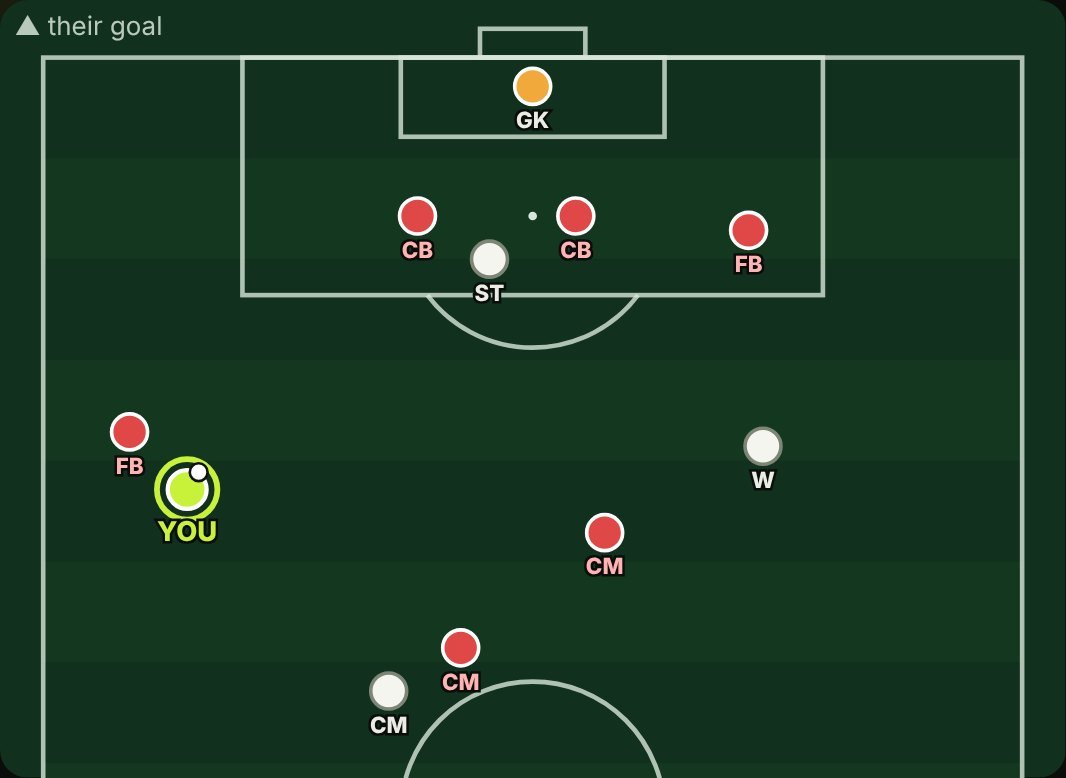
- A Go outside him, down the line
- B Cut inside him and attack the box (pro pick)
- C Play it back to your midfielder
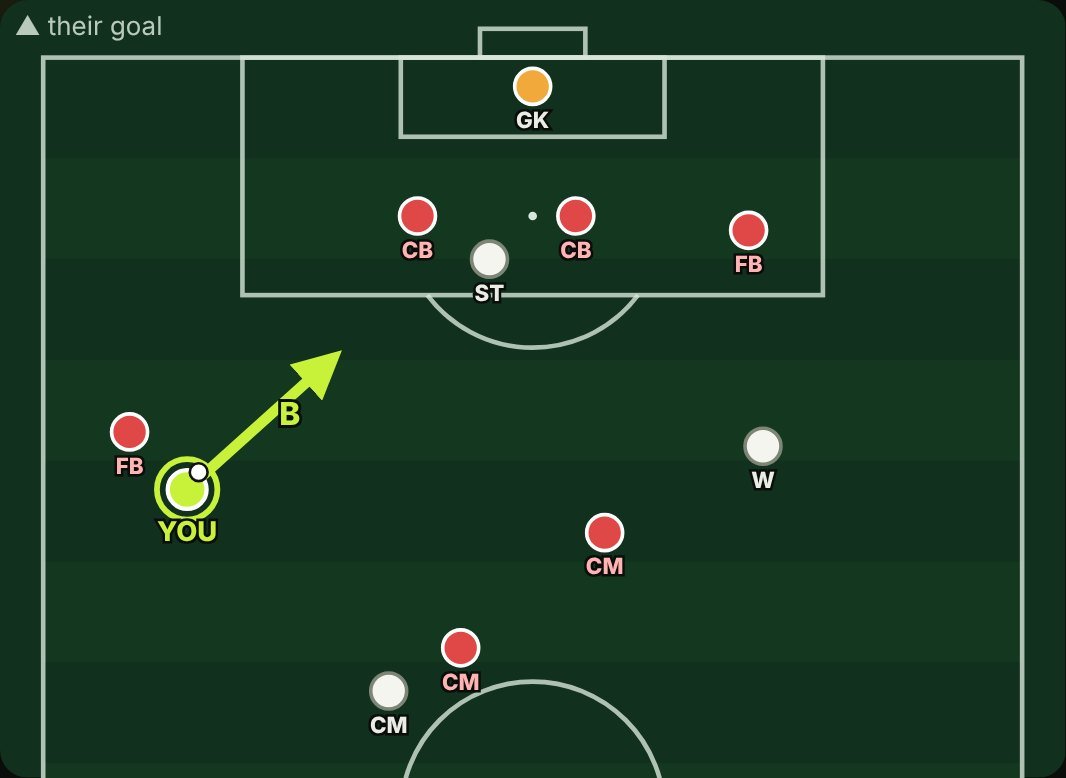
Their full-back stands on your outside, so going outside means going through him. Inside, their nearest midfielder is far away and your striker holds both center backs. Nobody covers the inside: cut across him, then shoot or slip your striker. Playing back (C) is right when a midfielder waits inside. Here it wastes a real chance.
Situation 2: on the byline, cross or cut-back?
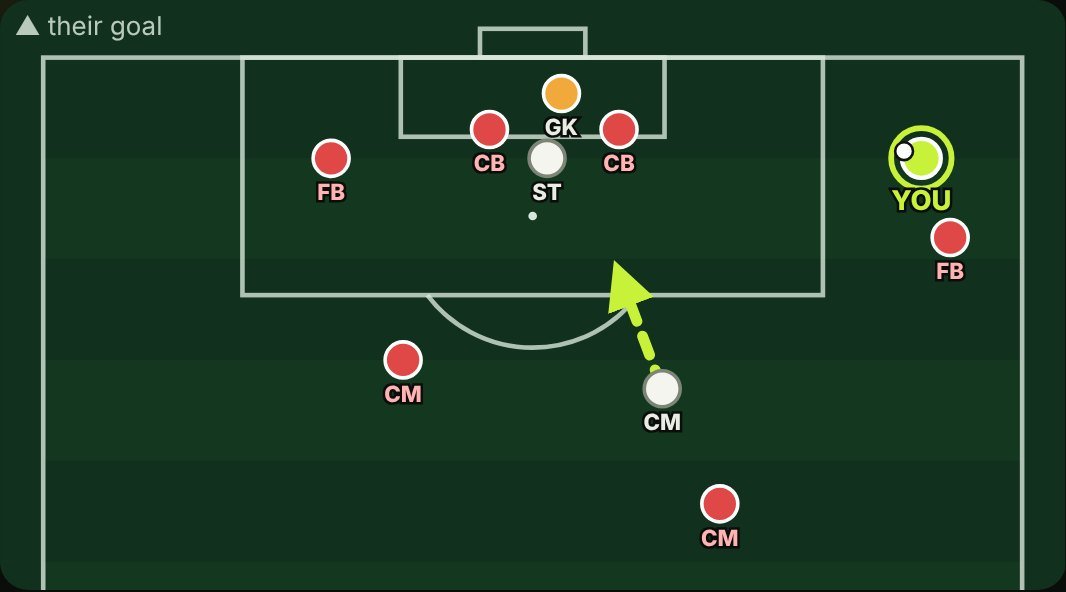
- A Drive it low and hard across the six-yard box
- B Shoot at the near post
- C Pull it back to your midfielder arriving at the penalty spot (pro pick)
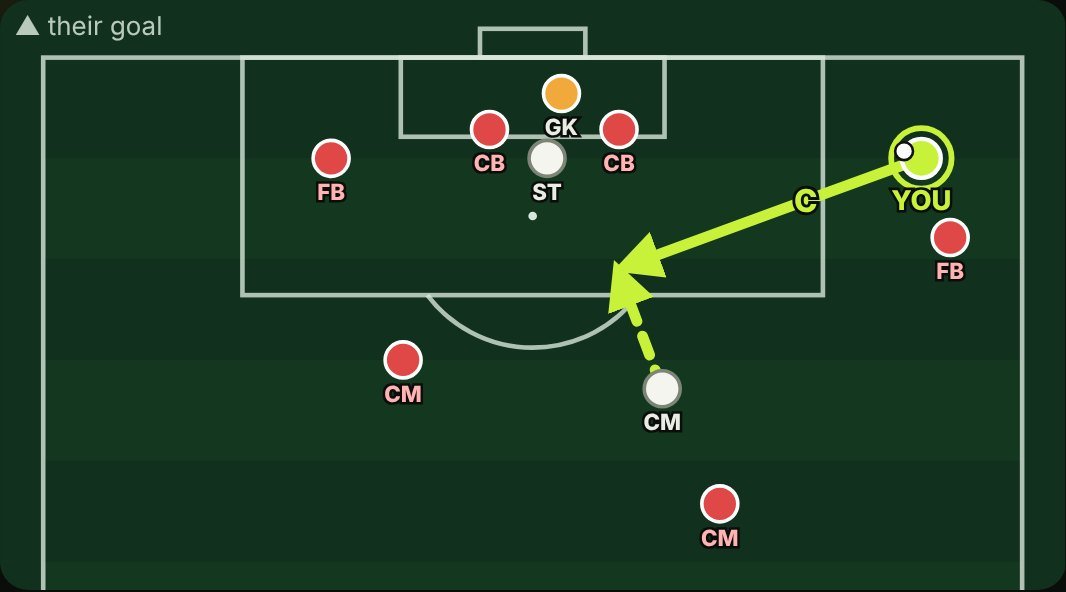
When a winger reaches the byline, defenders run back toward their goal. Here the keeper and both center backs are on the six-yard line with your striker squeezed between them, so a ball across (A) hits bodies. The near-post shot (B) is what the keeper wants: tiny angle, and he is on that post. The space is in front of their line, where your midfielder arrives with his marker trailing. Cut it back and he shoots facing goal.
Want the whole winger playbook?
The Winger Pack goes deeper than this page: a full set of winger rules for the 1v1, receiving, runs in behind and the final third, a 16-session cutting-inside progression, a 1v1 session, and breakdowns of 33 wide players to study. $17, one payment.
Situation 3: pressing their full-back
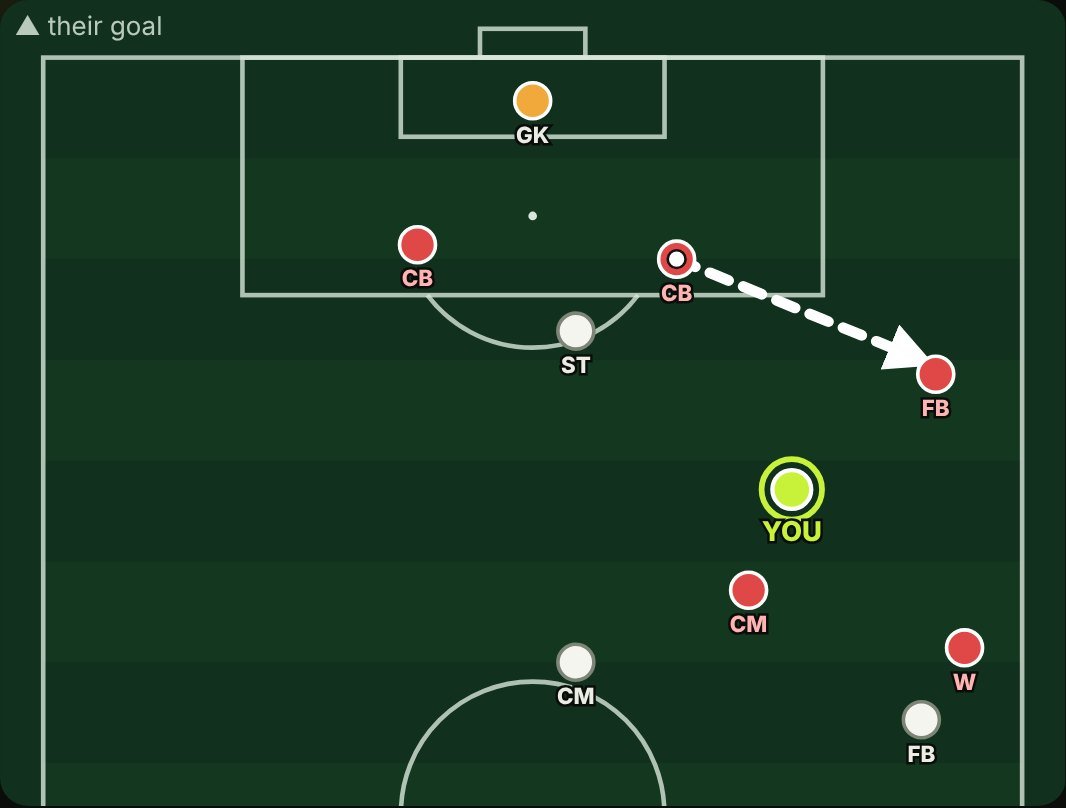
- A Curve your run from the inside and show him down the line (pro pick)
- B Go round the outside to stop him going down the line
- C Drop and mark their midfielder instead
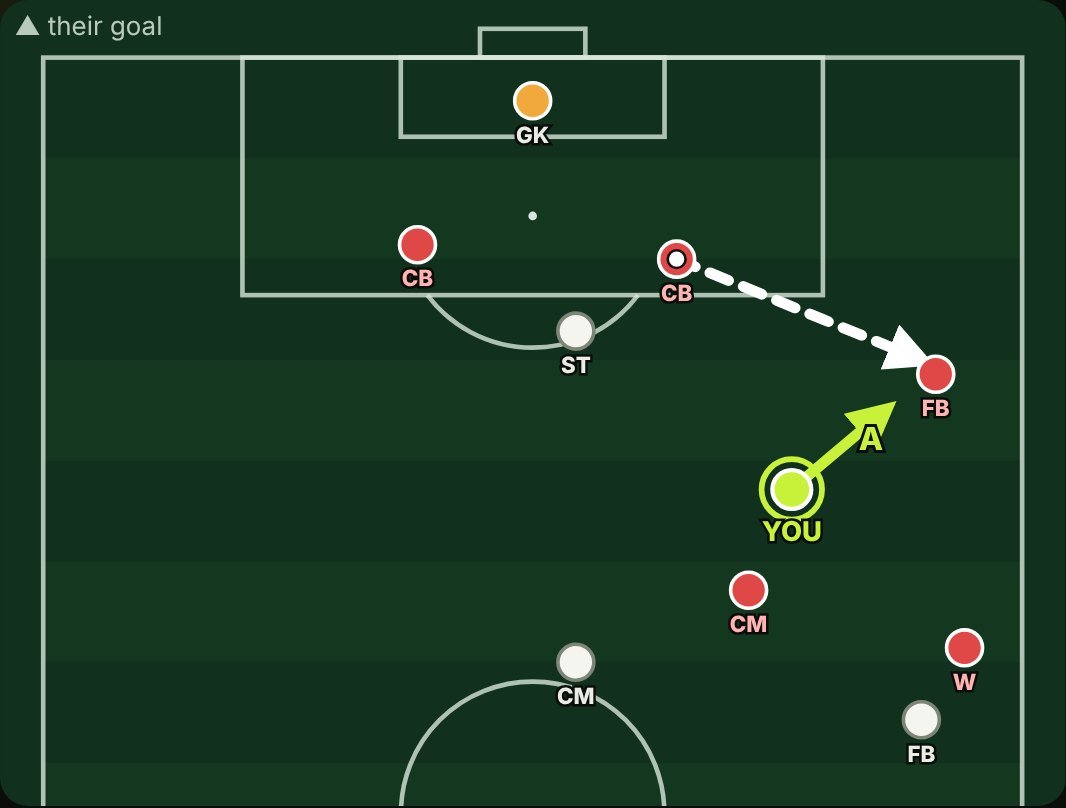
Their midfielder is free behind you. Come from the inside so your run blocks that pass, and push the full-back toward the touchline, where your full-back is waiting with their winger. Going round the outside (B) opens the pass inside. Dropping onto the midfielder (C) is fine if your team sits deep, but here nobody pressures the ball.
These three are a taste. Pause & Decide has 100 situations like this, 20 per position, including wingers. For the thinking behind it, read our guide to decision-making training.
What skills does a winger need?
A winger needs a sharp change of pace, a forward first touch, 1v1 dribbling, crossing and cut-backs with both feet, finishing from the side of the box, and the fitness to sprint repeatedly in both directions. Top speed helps, but changing speed and direction at the right moment matters more.
- Change of pace: slow the defender down, then burst past him. One feint plus a burst beats five tricks.
- First touch into space: move the ball away from the defender, don’t stop it dead.
- Both feet: if every touch goes onto your strong foot, the full-back only has to defend one side.
- Delivery: driven low crosses, cut-backs and floated balls to the back post, each for a different picture.
- Finishing: after cutting inside, shoot early.
How do you beat a full-back 1v1 as a winger?
To beat a full-back 1v1, receive with a first touch that already faces him, attack him at speed, make him stop or turn his hips with one feint, then burst past on the side the covering defender isn’t, and finish the move with a shot, cross or cut-back before he recovers. These five steps work alone against a cone or a friend.
- Face him with your first touch. Open your body on the half-turn and push the ball forward, so you’re running at him, not standing still.
- Attack him at speed. Run straight at his front foot. A defender backing off can’t commit; one who is attacked has to choose.
- Check the cover. Glance inside before you commit. If their midfielder is covering inside, go outside; if not, cut in.
- Feint once, then burst. One shoulder drop or step-over to make him stop or turn his hips, then change pace hard. One feint plus a burst beats five tricks.
- Finish the action. Once past him, shoot, cross or cut back within one or two touches. A beaten full-back recovers fast if you slow down.
What is a good weekly winger training plan?
You can train most winger skills with a ball, a wall, a few cones and a goal or target. Each session below takes 30 to 45 minutes; fit three or four around team training and games. One focus per session, and finish with game-speed reps.
| Day | Focus | What to do | Alone or friend |
|---|---|---|---|
| Monday | Receiving on the half-turn | Wall passes from 8 to 10 meters. Check your shoulder, receive side-on on your back foot, first touch forward past a cone. 4 sets of 10, both sides. | Alone |
| Tuesday | 1v1 and change of pace | Friend defends a 10 x 15 meter channel. One feint, then burst: 5 outside, 5 inside, swap roles. 3 rounds. | One friend (or a cone “defender”) |
| Wednesday | Rest or study | Watch one half of a winger on TV with the checklist below. Write three things to copy. | Alone |
| Thursday | Cutting inside and finishing | Dribble at a cone from wide, cut inside, shoot within two touches. 10 each side, then 10 at full speed. | Alone |
| Friday | Delivery | From the byline: 10 cut-backs to the penalty spot, 10 driven to the near post, 10 floated to the back post. Both sides. | Alone, or friend finishing |
| Saturday | Game | Count your 1v1s, your touches in the box, and your far-post runs. | Team |
| Sunday | Rest and decisions | 10 minutes on situations: the free test or Pause & Decide. Pick the option, then check why. | Alone |
Sprint work matters for wingers, but add it slowly if you aren’t used to it, and stop if anything hurts. Short sprints of 10 to 30 meters with full rest between them are the most game-like.
Which famous wingers should you study, and how?
Study a winger who plays your side and your style. Traditional wingers like Garrincha and David Beckham show crossing and delivery; inverted wingers like Arjen Robben, Mohamed Salah and Bukayo Saka show cutting inside onto the strong foot; Vinícius Júnior shows 1v1 dribbling from the left.
| Winger | Type | What to watch for |
|---|---|---|
| Garrincha (Brazil) | Traditional, right side | Beating the full-back on the outside and crossing |
| David Beckham (England) | Wide right midfielder | Early crosses and delivery without needing to beat his man |
| Ryan Giggs (Wales) | Traditional, left side | Running at defenders with the ball close and going down the line |
| Arjen Robben (Netherlands) | Inverted, right side | Cutting inside onto his left foot and curling to the far post |
| Mohamed Salah (Egypt) | Inverted, right side / wide forward | Runs in behind from wide and finishing from inside the box |
| Bukayo Saka (England) | Inverted, right side | Receiving on the half-turn and combining with his full-back |
| Vinícius Júnior (Brazil) | Left side, 1v1 dribbler | Change of pace in the 1v1 and runs in behind |
We name national teams, not clubs, because players move (checked October 2026). Watch full matches, not goal compilations: compilations skip the runs and decisions before each goal.
How to study one: to learn from a winger on TV, watch him for a full half without following the ball: where he stands in build-up, what he does when the ball is on the other wing, his body shape before receiving, and how he presses. Highlights never show these moments.
- Before he receives: does he check his shoulder? Is he side-on or facing his own goal?
- In the 1v1: which way does he go, and where was the covering defender when he chose it?
- On the byline: does he cross or cut it back? Where were their defenders at that moment?
- Ball on the far side: does he stay wide or attack the box? Does he arrive early or late?
- Without the ball: how does he press the full-back, and does he track runs back?
Pause just before he receives, decide what you would do, then press play. Our guide to analyzing a match as a player explains the method. Wingers who check their shoulder before receiving have more options, so test yours with the free football scanning test and see how to scan in soccer. Pick a winger who plays your side.
What are the most common winger mistakes?
The most common winger mistakes are staying on the touchline when the ball is on the other side, always coming to feet instead of running in behind, dribbling into crowds, taking one touch too many before shooting, and switching off when the team loses the ball.
- Hugging the touchline on the far side. When the cross comes from the other wing, be in the box.
- Only coming to feet. A winger who never runs in behind is easy to defend. Make the run even if the ball doesn’t come.
- Dribbling into traffic. The dribble is for space and 1v1s. In a crowd, pass and keep moving.
- One touch too many. When the chance is there, shoot or deliver. Extra touches let defenders block.
- Not defending. If you don’t track the full-back, your own full-back is 2v1. Coaches notice this fast, including at tryouts.
Playing a different position? See our guides for the striker, the number 10 and the center back.
Train like a winger, decide like one
Start with Unscouted’s free test: 8 match situations, no sign-up. Then take the Winger Pack for the full winger rules, the cutting-inside progression, the 1v1 session and 33 wide players broken down.
FAQ
What is a winger in soccer?
A winger is an attacking player who plays wide on the left or right, near the touchline. Wingers stretch the defense, beat defenders 1v1, cross and cut the ball back, score goals and press the opposing full-back.
Is a winger a midfielder or a forward?
It depends on the formation. In a 4-3-3 the wingers are forwards in the front three. In a 4-4-2 the wide players are usually called wide midfielders and defend deeper.
What is the difference between left wing and right wing in soccer?
It is the same role on opposite sides. The bigger difference is footedness: a winger on the side of their strong foot tends to go down the line and cross, while an inverted winger plays on the opposite side and cuts inside to shoot.
What is an inverted winger?
An inverted winger plays on the side opposite their stronger foot, such as a left-footer on the right wing. It lets them cut inside to shoot or pass with their strong foot, and it leaves the touchline free for an overlapping full-back.
What number does a winger wear?
Traditionally 7 for the right winger and 11 for the left winger. Today shirt numbers are mostly personal choice.
What makes a good winger?
A good winger combines a change of pace, a forward first touch and 1v1 skill with good decisions: when to go inside or outside, when to cross or cut back, and when to run in behind. Pressing and tracking back matter too.
How can I train to be a winger on my own?
Train half-turn receiving against a wall, 1v1 changes of pace with a friend or cones, cutting inside and finishing within two touches, and cut-backs and crosses from the byline. Add decision practice by pausing match footage or using situation tests.
What formation is best for wingers?
A 4-3-3 gives wingers the most attacking freedom: you start high as a wide forward and attack the full-back. A 4-2-3-1 also suits wingers who like to cut inside and combine. In a 4-4-2 you defend more as a wide midfielder, and in a back three the role usually goes to wing-backs.
Do wingers have to defend?
Yes. A modern winger presses the opposing full-back, blocks the pass into midfield and tracks overlapping runs. How deep you defend depends on the formation: high in a 4-3-3, in the midfield line in a 4-4-2.
Do wingers need to be fast?
Speed helps, but a change of pace matters more than top speed. Many good wingers beat full-backs with a feint, a quick first step and good timing. Crossing, decisions in the final third and work rate count as much as pace.
Sources: Minnesota United FC, Understanding the Game: Inverted Wingers · Wikipedia, Winger (sports)