POSITION GUIDE · CENTER BACK
Center Back in Soccer: What the Position Is and How to Play It Well
What a center back does, the five types, the decisions that make a good one, three match situations on a tactics board and a weekly plan you can do alone or with one friend.
Try the free soccer IQ test →Quick answer: A center back is a central defender who plays in the middle of the back line, directly in front of the goalkeeper. The job is to stop the other team scoring through the middle: marking strikers, winning headers, covering a teammate and holding the defensive line, then starting attacks with simple, safe passes. Most teams play two center backs in a back four or three in a back three, and what makes a good one is mostly decisions (when to step up, when to drop, who to mark), which Unscouted’s free soccer IQ test lets you practice on real match pictures.
Key takeaways
- A center back (also called a central defender or center half) plays in the middle of the defense, usually wearing 4, 5 or 6.
- Types: stopper, cover, ball-playing center back, sweeper (libero) and the wide center back in a back three.
- The step-or-drop rule: pressure on the ball means the line can step up; a free passer with his head up means drop.
- You can train most of the position alone or with one friend, decisions included.
What is a center back in soccer?
A center back is one of the defenders who play in the center of the back line, closest to their own goal apart from the goalkeeper. Their main job is to protect the space in front of the goal: stop through balls, win the duel with the striker, clear crosses and keep the back line organized. In possession, they start the attack.
You will also hear “centre-back” (UK spelling), “center half”, “central defender” or just “CB”. In football outside the US the role is the same.
Where you stand depends on the formation:
- Back four (4-3-3, 4-4-2, 4-2-3-1): two center backs, a left center back and a right center back, with a full-back outside each of them.
- Back three (3-5-2, 3-4-3): three center backs. The middle one usually organizes the line and covers; the two outside ones (wide center backs) step out to the channels and often carry the ball forward.
What are the different types of center back?
There are five common center back types: the stopper, the cover defender, the ball-playing center back, the sweeper (libero) and the wide center back in a back three. Most players mix two, and good partnerships pair different styles.
| Type | What they do | Main strength |
|---|---|---|
| Stopper | Steps out early to challenge the striker, often before he can turn | Aggression, timing, winning duels |
| Cover | Sits a few yards behind the stopper and sweeps up balls in behind | Reading the game, recovery pace |
| Ball-playing center back | Breaks lines with passes and carries the ball into midfield | Calm on the ball, passing range |
| Sweeper (libero) | A free defender behind the line with no fixed man; rare in modern soccer | Anticipation, organizing |
| Wide center back (back three) | Defends the channel, steps out to wingers, overlaps or carries forward | Mobility, 1v1 defending in space |
The sweeper faded as teams moved to flat, compact back lines; part of the job moved to the “sweeper keeper”.
What is the difference between a left and right center back?
A left center back plays on the left of the central pair and a right center back on the right. The defending job is the same; the difference is the passing angles. A left-footed player on the left can open his body to pass to the left back and down the left channel without turning back inside, which is why many coaches like one left-footer in the pair.
| Left center back | Right center back | |
|---|---|---|
| Usual stronger foot | Left, if the team has one | Right |
| Main passing angles | Left back, left channel, switch to the right | Right back, right channel, switch to the left |
| Covers | Space behind the left back | Space behind the right back |
| Cross from your side | Usually takes the near post and first runner | Takes the middle (and the reverse when the cross comes from the right) |
The partnership: good pairs share the jobs. Often one is more aggressive and steps to the striker (stopper), while the other reads the game and covers (cover). They talk all game, stay 10 to 15 yards apart in a back four, and swap roles depending on which side the ball is. The worst partnership is two center backs who both step at the same time, or both drop.
How does a center back play in a back four vs a back three?
In a back four there are two center backs, so you share the middle with one partner and the full-backs protect the wide areas. In a back three you might be the middle center back, who organizes and covers, or a wide center back, who steps out to wide areas, carries the ball forward and sometimes overlaps.
| Role | Formation | Main jobs |
|---|---|---|
| Center back in a pair | 4-4-2, 4-3-3, 4-2-3-1 | Mark the striker or cover your partner, defend the box, pass into midfield |
| Middle center back | 3-5-2, 3-4-3 | Organize the line, cover both sides, deal with the striker in the middle |
| Wide center back | 3-5-2, 3-4-3 | Defend the channel, step out to wide attackers, carry the ball forward, support the wing-back |
Common pairings: two ball-players for teams that build from the back, a stopper with a cover for teams that defend deeper, and two aggressive press-steppers for teams that press high. Know which one your coach wants, and which of the two you are.
What skills does a center back need?
A center back needs good positioning, 1v1 defending, heading, passing under pressure, communication and concentration for the full match. Size and pace help, but a center back in the right place needs far fewer last-ditch tackles.
- Positioning: goal-side of your man, ball and man in view, connected to your partner.
- 1v1 defending: side-on stance, show the attacker away from goal, stay on your feet.
- Heading: attack the ball, head it high, far and wide.
- Passing: both feet if possible, a firm pass into midfield, a long diagonal.
- Scanning: check your shoulders before the ball comes (see how to scan in soccer).
- Talking: short, early calls: “step”, “drop”, “man on”.
How do you defend 1v1 as a center back?
To defend 1v1 as a center back, close the attacker down while the ball travels to him, slow down a few yards away, get side-on in a low stance, show him away from goal onto his weaker side, and stay on your feet until his touch goes too far or help arrives. Patience wins more 1v1s than diving in.
- Close down while the ball travels. Sprint when the pass is played, so he receives under pressure and can’t turn easily.
- Slow down 2 to 3 yards away. Short, quick steps. Arriving at full speed lets him go past you with one touch.
- Get side-on and low. Knees bent, weight on the balls of your feet, one foot in front, so you can turn and run either way.
- Show him away from goal. Angle your body to push him toward the touchline or his weaker foot, and toward a teammate who can help.
- Stay on your feet, then win it. Delay until he takes a heavy touch, looks down or a teammate arrives. Then tackle, or block the shot or cross.
How do center backs lead and communicate?
Center backs lead by talking early and simply. From the back you see the whole pitch, so your job is to tell teammates what they can’t see: when to step, when to drop, who picks up which runner. Use short, agreed one-word calls, made before the moment, not after it.
| Call | What it means | When to use it |
|---|---|---|
| “Step” / “Up” | Back line moves forward together | Ball goes backward or their passer is under pressure |
| “Drop” | Back line retreats a few yards | Their passer is free and looking up |
| “Man on” | An opponent is closing the teammate on the ball | Before he receives |
| “Time” | No pressure, take a touch | Teammate receiving with space |
| “Yours” / “Mine” | Who takes the man or the ball | A striker drops, or two players go for one ball |
| “Away” | Clear it, no risk | Ball loose in your box |
| “Keeper” | The goalkeeper is coming for the ball | Called by the keeper; you leave it |
Line height and the keeper: the higher your line, the more space behind it, so your keeper has to come out to sweep balls over the top. Agree with him before the game how high you’ll play. Against a fast striker, a slightly deeper line is often safer.
How does a center back decide what to do?
Most of a center back’s work is choosing between two or three reasonable actions in under a second: step up or drop, follow the striker or stay, near post or back post, pass or clear. Each rule below gives you a default and the cue that tells you when to break it.
1. Step up or drop? Look at the player on the ball
If the passer is under pressure, has his back to your goal or his head is down, he can’t hit a ball over you, so step up and squeeze the space. If he is free and looking up, drop a few yards. Move as a line: one defender out of line plays the whole attack onside. Under Law 11, an attacker is offside only if he is nearer your goal line than both the ball and the second-last defender, so the deepest defender sets the line.
2. When should you follow a striker who drops?
Follow him and get tight only if three things are true: someone covers the space you leave, no runner is attacking it, and you can arrive before he turns. If one is missing, hold your spot and pass him on to a midfielder with a shout (see situation 1).
3. Pressure, cover, balance with your partner
When your partner steps out to the ball, you are the cover: tuck in behind him at an angle so if he is beaten you are next. The far full-back is the balance, coming narrow to protect the middle. The jobs swap every time the ball moves, so keep asking which one you are.
4. Defending crosses: get goal-side, then decide near post or back post
Before the cross, get goal-side of your man with your body open so you see him and the ball. The center back nearer the ball usually takes the near post area and the first runner; the far center back takes the middle; the far full-back tucks in to the back post. If a zone is empty and a runner is heading for it, it becomes your job. Then attack the ball and head it high and wide.
5. Playing out under pressure: midfield, switch or clear?
Before the pass reaches you, look at where the pressure comes from. Then use this order:
| Option | Choose it when | Avoid it when |
|---|---|---|
| Pass into midfield | Your midfielder has a few yards of space and can see you | A marker is tight on his back |
| Switch to the far side | Their press is crowding your side and the lane is open | A presser is running across the line of the pass |
| Carry it forward | Nobody presses you; dribble until someone has to leave his man | You are already being closed down |
| Back to the keeper | No forward option and the keeper is free | The presser is between you and him |
| Clear it long | You are under real pressure close to your goal with no safe pass | A simple pass is on |
One rule with almost no exceptions: never play a square pass across the front of your own box. Since the 2019 goal kick change, the ball is in play once it is kicked and clearly moves, so build-up often starts with you receiving inside your own box.
What does a center back do at set pieces?
At set pieces a center back usually defends the most dangerous area in front of goal, marks the other team’s best header or guards a zone, and at attacking corners and free kicks often goes forward to attack the ball, because center backs tend to be among the best headers in the team.
- Defending, man-marking: get goal-side and touch-tight before the kick, keep your eyes on the ball and your man, attack the ball first.
- Defending, zonal: own your zone, attack any ball that enters it, and don’t back off toward the goal line.
- After the first header: the whole line steps out together to push attackers offside for the second ball.
- Attacking corners: start away from where you want to go, then run late and attack the ball at its highest point. Someone has to stay back, so agree who.
How has the center back role changed?
The center back role has moved from pure defending to defending plus building play. Two Laws of the Game changes drove it (checked October 2026): since 1992 the keeper can’t pick up a deliberate back pass kicked by a teammate, and since 2019 a goal kick is in play as soon as it is kicked and clearly moves, so center backs can receive inside their own box.
| Then | Now |
|---|---|
| Mark the striker, win headers, clear it | Still all of that, plus passing through the press and carrying the ball forward |
| Back pass to the keeper’s hands to waste time | Keeper must play the back pass with his feet, so you need a safe angle for him |
| Goal kicks went long | Many teams start short, with center backs receiving in or near their own box |
| Deep line, sweeper behind | Higher, flat lines with the keeper sweeping, and center backs stepping into midfield to press |
For a player 15 to 21, that means a center back who can’t pass under pressure has fewer options at higher levels. Train both.
What would you do as a center back in these situations?
Look at each board, choose A, B or C, then read the answer. The right choice always depends on a detail you can see. More on training this in football decision-making training.
Situation 1: their striker drops short
25′, 0-0. You are the left center back. Their striker drops toward halfway for a pass into his feet. Your goal is at the top.
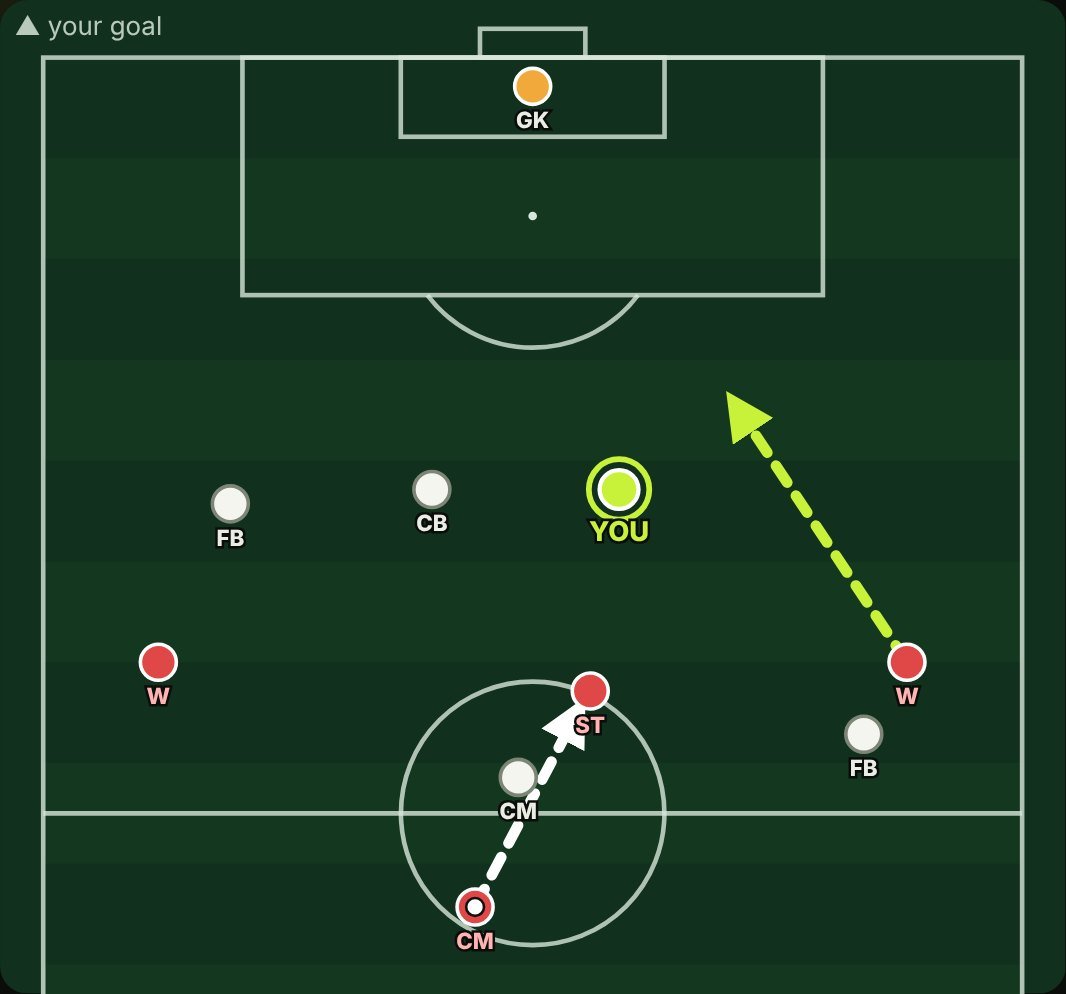
What do you do?
- A Follow him and get tight before the ball arrives.
- B Hold your spot and let your midfielder close him. (pro pick)
- C Drop to the edge of your box.
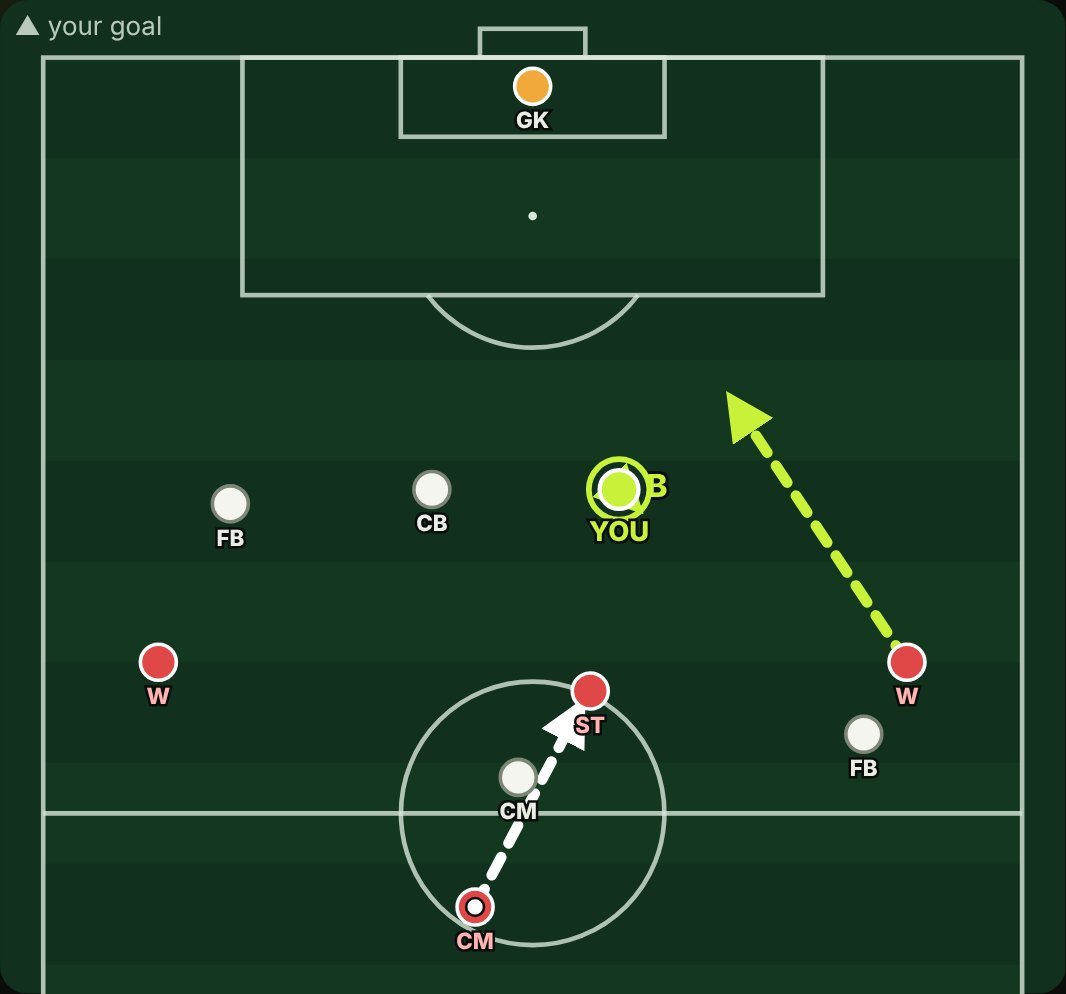
Why B: Their right winger is running into the gap between you and your left back, who is caught upfield. Your midfielder is a few yards from the striker and can stop him turning. Stay, shout “yours”, and guard the space.
Why not A: Right only when someone covers the space you leave (rule 2). Here nobody does.
Why not C: It gives the striker time to turn and pulls your line back for nothing.
Situation 2: a cross from the byline
62′, 1-1. Their right winger has beaten your left back near your byline. You are the center back nearest the ball.
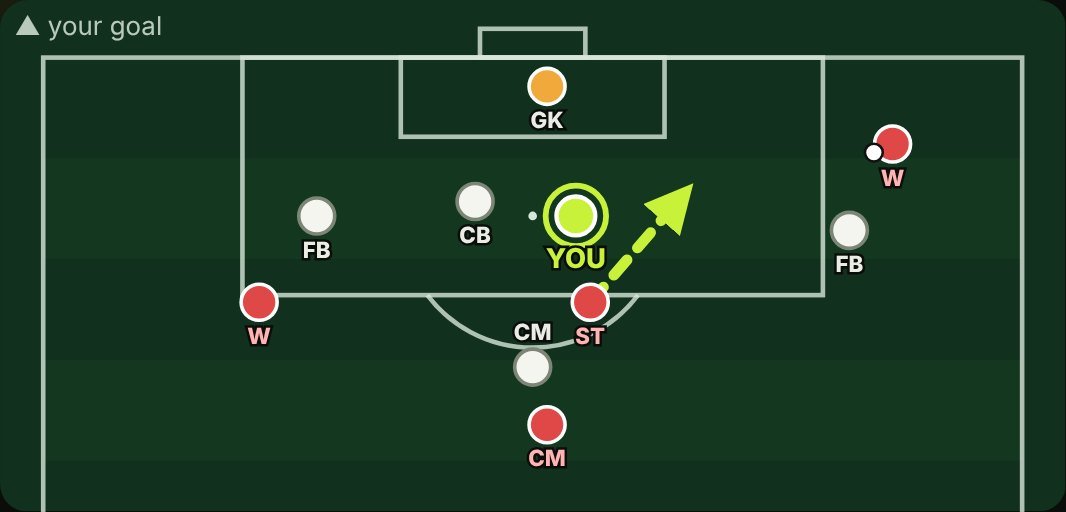
What do you do?
- A Step out to the penalty spot to block a cut-back.
- B Stay level with your partner and watch the ball.
- C Get across to the near post, goal-side of their striker. (pro pick)
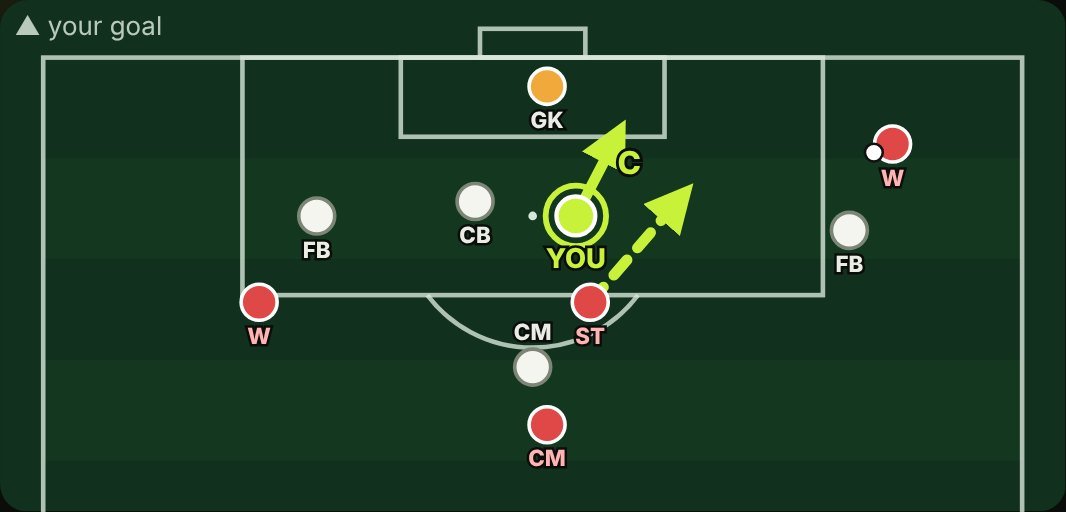
Why C: Their striker is sprinting to the near post and nobody is on it. The back post is covered by your partner and your right back, and your midfielder is goal-side of the cut-back runner. The near post is yours: get there first, goal-side, and attack the ball.
Why not A: The cut-back is often the most dangerous ball from the byline, but your midfielder already has it covered.
Why not B: If you only watch the ball, the striker reaches the near post before you.
Situation 3: playing out under pressure
14′, 0-0. You are the right center back. Your partner passes across to you and their striker chases the pass. Their goal is at the top.
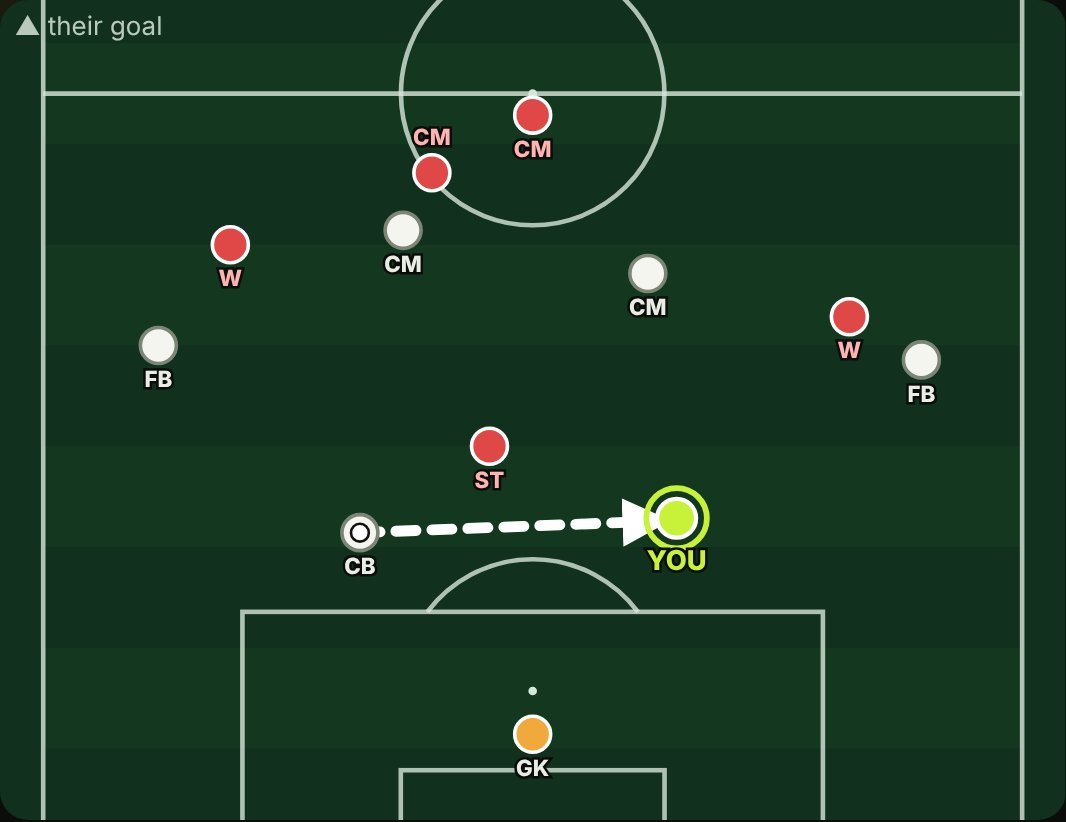
What do you do?
- A Pass into your midfielder. (pro pick)
- B Switch it long to your left back.
- C Clear it long down the right.
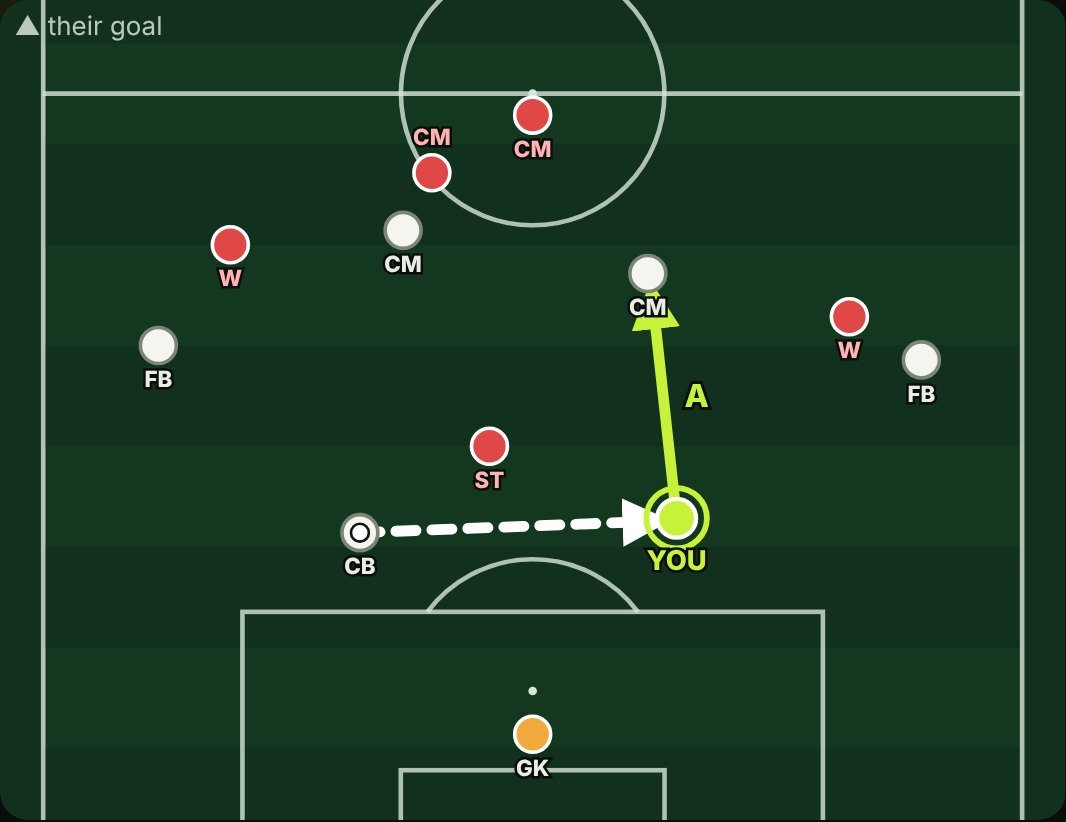
Why A: Your right-sided midfielder has more than ten yards to the nearest opponent and is half-turned. The striker’s press has left the middle open. A firm pass into him beats their first line.
Why not B: A switch is good when one side is crowded, but their striker is running straight across the line of that pass.
Why not C: Nobody is close enough to force a clearance. You give the ball away when a simple pass is on.
Go deeper: the Defender Pack
The $17 Defender Pack has the full defender’s code (15 rules, 1v1 stance to set pieces), seven sessions for one player or a few friends, what to watch in six top defenders, and match worksheets. Pause & Decide has 100 situations like these, 20 for defenders.
How do you train as a center back alone or with one friend?
You can train most of what a center back needs with a ball, a wall, a few cones and sometimes one friend. Add three short, sharp sessions a week to team training. A sample week:
| Day | Session (30–40 min) | Who | What it trains |
|---|---|---|---|
| Monday | Footwork: side-on backpedal, side shuffle, hip turn and sprint 5 yards, 4 rounds | Alone | Defending stance, turning quickly |
| Tuesday | Wall passes with a shoulder check, both feet, then 10 long passes at a target 30–40 yards away | Alone | Playing out, passing range |
| Wednesday | Team training or rest | Team | Recovery |
| Thursday | 1v1 in a 10-yard channel: show him one way, stay on your feet. Then a few thrown crosses to head high and wide | 1 friend | 1v1 defending, heading technique |
| Friday | 10 minutes of decision situations, then light passing | Alone | Step or drop, crosses, playing out |
| Weekend | Match, then note three decisions you would change | Team | Applying it |
Heading: keep heading reps low and follow your club’s or federation’s heading guidance. U.S. Soccer has heading rules for younger age groups. If something hurts, stop and talk to a qualified professional.
Working toward trials? Read pro soccer tryouts to see what clubs look for.
How do you analyze a center back on TV?
Pick one center back and follow only him for 15 minutes of a full match, not highlights. Highlights show tackles; full matches show the positioning that prevents them.
- Step or drop: each time the line moves, was there pressure on the ball?
- Ball on the far side: where does he stand?
- His partner steps out: does he tuck in behind as cover?
- Before he receives: does he look first?
- Crosses: which zone does he take, near post, middle or back post?
- Talking: who does he organize?
Write down three things to copy. The same method works for the striker, winger and number 10, the attackers you will face. Center backs scan more than most positions, so check yours with the free football scanning test, and use our match analysis guide for the full method.
Who are famous center backs, and what can you learn from them?
Famous center backs include Franz Beckenbauer, Franco Baresi and Paolo Maldini from earlier eras, and Virgil van Dijk, Rúben Dias and William Saliba today. Watch each for one strength.
- Franz Beckenbauer (West Germany, Bayern Munich): the classic libero, stepping into midfield with the ball.
- Franco Baresi (AC Milan, Italy): organizing a high, compact line and reading danger early.
- Paolo Maldini (AC Milan, Italy): left back and center back, clean, well-timed defending.
- Virgil van Dijk (Netherlands, Liverpool from 2018): staying on his feet in 1v1s and long diagonal passes.
- Rúben Dias (Portugal, Manchester City from 2020): low 1v1 stance and constant organizing.
- William Saliba (France, Arsenal): stepping out to win the ball and calm passing through the lines.
What are the most common center back mistakes?
The most common center back mistakes are watching only the ball, diving into tackles, stepping out alone, following the striker everywhere and playing risky passes across your own box. Almost all are decision mistakes, not technical ones.
- Ball-watching: the runner behind you scores. Check your shoulder.
- Going to ground: delay first, tackle on a bad touch.
- Stepping alone: you play everyone onside. Move as a line.
- Following the striker everywhere: you leave the space behind you empty (situation 1).
- Square passes across your box: one interception is a free shot.
Test your center back decisions
8 free match pictures, 3 options each, then the pro pick and why. No sign-up.
FAQ
What number does a center back wear?
Traditionally 4 or 5, and in some countries, including England, 5 and 6. Pros keep a squad number for the season, so a center back can wear almost any number.
Is center back the hardest position in soccer?
No position is objectively the hardest. Center back is one of the most punishing, because a single mistake often leads straight to a goal, and it needs concentration for the full match. Many players find it easier to learn than attacking roles because good positioning does a lot of the work.
What is the difference between a center back and a full-back?
A center back defends the middle of the pitch in front of goal and deals mainly with strikers and crosses. A full-back plays on the left or right of the back line, defends wingers and often gets forward down the touchline.
Can you be a center back if you are short?
Yes, although height helps in the air. Fabio Cannavaro, around 5 ft 9 in, won the Ballon d’Or in 2006 as a center back. Shorter center backs rely more on timing, positioning and reading the game.
What is a ball-playing center back?
A center back chosen partly for passing: he breaks lines with passes into midfield, switches play and carries the ball forward when unpressed.
How do I become a better center back on my own?
Train footwork, passing with both feet against a wall and heading technique in small doses, practice decisions with match pictures, and watch one center back for 15 minutes of a full game.
What is the difference between a left and right center back?
The defending job is the same; the difference is the passing angles and which full-back you cover. A left-footed player on the left can pass to the left back and down the left channel without turning inside, which is why many coaches like one left-footer in the pair.
What does a wide center back do in a back three?
A wide center back defends the channel between the middle center back and the wing-back, steps out to wide attackers, and in possession carries the ball forward or passes into midfield. Some even overlap when the wing-back moves inside.
How do you defend 1v1 as a center back?
Close the attacker down while the ball travels, slow down 2 to 3 yards away, get side-on and low, show him away from goal onto his weaker side, and stay on your feet until his touch goes too far or help arrives.
What should a center back say during a game?
Short, agreed calls made early: step or up to push the line, drop to retreat, man on to warn a teammate, time when he’s free, yours or mine to decide who takes a runner, and away to clear it.
Sources: IFAB Laws of the Game, Law 11 Offside (checked October 2026) · IFAB Laws of the Game, Law 16 The Goal Kick (checked October 2026) · The FA Boot Room, Top tips for developing central defenders of the future