GUIDE · DECISION MAKING
How to Improve Decision Making in Football (as a Player)
A simple 3-step way to make better choices on the ball, three real match situations worked through on a tactics board, and a 15-minute routine you can do on your own.
Take the free test →Quick answer: Most bad decisions in football start before the ball reaches you. You look too late, so you only see one option. To improve, look around before the ball arrives, compare three options (forward, keep it, switch or go alone), and commit to one. Then train the reading part on its own: work through match situations, watch games with one question in mind, and review your own decisions after each match.
Why you make the wrong decision
When a coach says “bad decision”, it sounds like you picked the wrong answer. Usually that isn’t what happened. You picked the only answer you saw.
Think about the last time you lost the ball in midfield. Did you know a defender was behind you before the ball arrived, or did you find out when he took it? The mistake usually happened seconds earlier, when you watched the ball roll towards you instead of looking around.
So there are really two skills here:
- Seeing the picture: where the space is, who is free, who is closing you, how deep their back line is.
- Choosing from it: knowing which of your options is best for that picture, and doing it without hesitating.
Both can be trained. Neither needs an academy, a coach or special equipment. The FA’s Boot Room article on developing decision-makers makes a related point for coaches: practice that changes and varies, like real games, tends to build decision-making better than the same drill repeated in blocks. That is a coaching view, not a law.
The 3-step decision: look, compare, commit
Use this every time the ball is coming to you.
1. Look before the ball arrives
Check over your shoulder while the pass is being played and while it travels. You are looking for three things: the nearest opponent, the nearest free teammate, and the space behind their line. If you only manage one look, make it the one just before the ball reaches you.
2. Compare three options
Nearly every moment in football comes down to about three choices:
- Forward: pass, run or shoot towards goal.
- Keep it: a safe pass back or sideways, or shielding the ball.
- Change it: switch the play, go 1v1, or play a one-two.
You don’t need to think through all three every time. Just know they exist, so you aren’t stuck with the first idea you have.
3. Commit
A good option done halfway is usually worse than an average option done fully. Once you choose, do it properly. Hesitation is where a lot of lost balls come from.
Honest caveat: there is rarely one “correct” answer in football. The situations below have a best option for the picture shown, the one a good coach would want. Change one player’s position and the answer can change. That is the whole point: the answer comes from the picture, not from a rule.
Situation 1: winger receiving on the touchline
You are the right winger. It is 0-0 after 34 minutes. Your right back plays it up the line to you. Their left back is in front of you. Look at the board for a few seconds before reading the options.
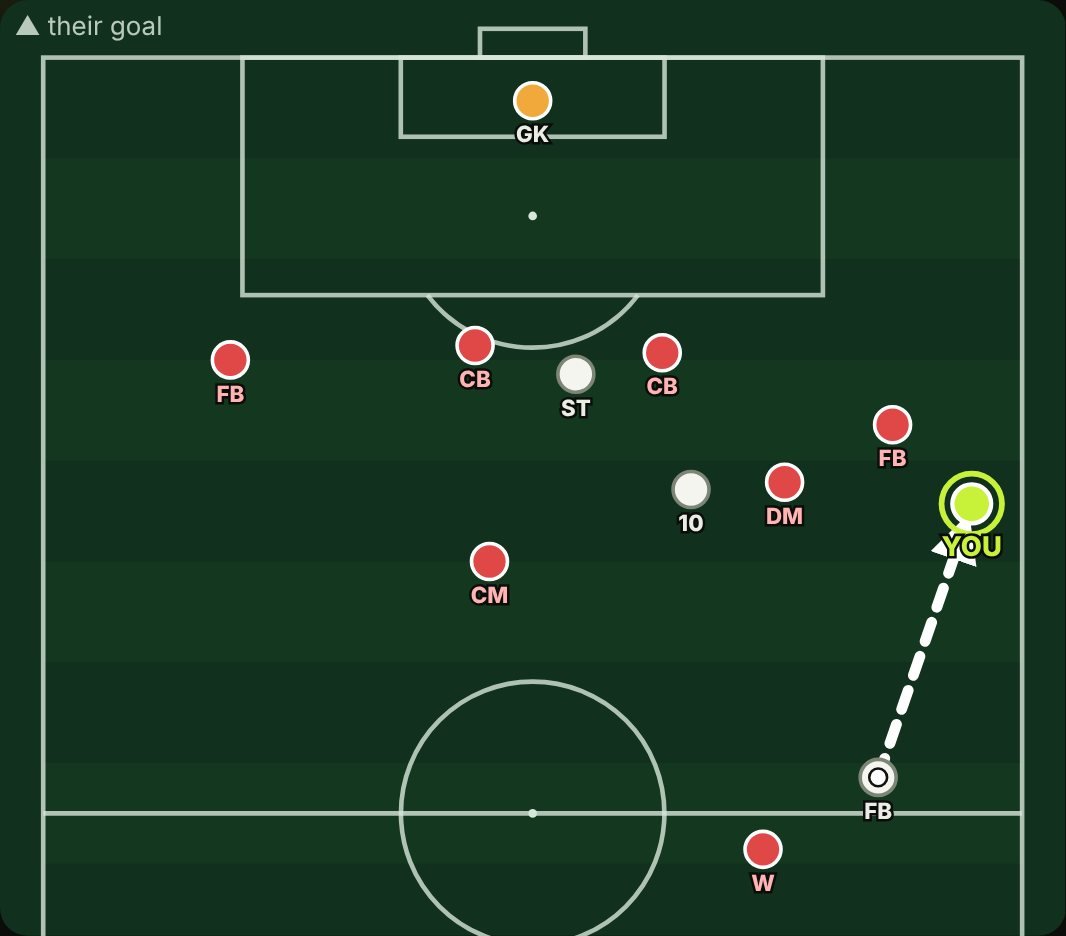
What do you do?
- A Play it inside to your 10.
- B Lay it back to your right back and go again.
- C Take him on down the line. (pro pick)
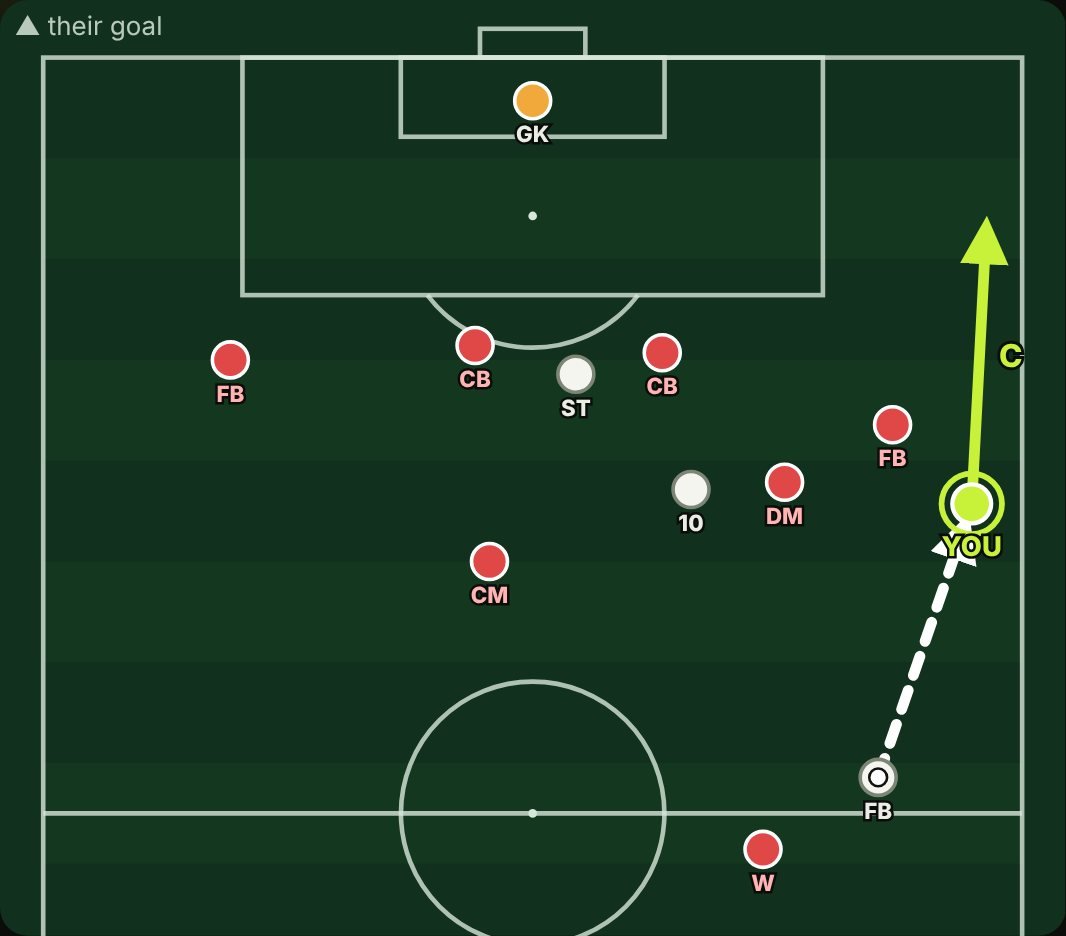
Why C: Look behind their left back. Their nearest centre back is about 17 metres inside him, and their winger has stayed up near halfway. Nobody is covering him. He has also set himself on your inside to stop you cutting in. That leaves the line. Beat him there and you are at the byline with a cross to make, which is exactly the situation a winger wants.
Why not A: Your 10 looks free, but their defensive midfielder is standing in the passing lane. If it gets cut out, they break down your side, where your right back has just come from.
Why not B: It is safe and keeps the ball. If their full-back had a covering centre back close by, or their winger had tracked back to double you, laying it back would be the smart choice. Here you would be giving up the best 1v1 you will get all half.
The lesson: before you decide whether to take a full-back on, look at who is behind him, not just at him. Winger-specific situations like this are in the Winger pack.
Situation 2: number 10 between the lines
You are the number 10. It is 0-0 in the 58th minute. Your midfielder plays it into your feet between their lines. Your back is to their goal.
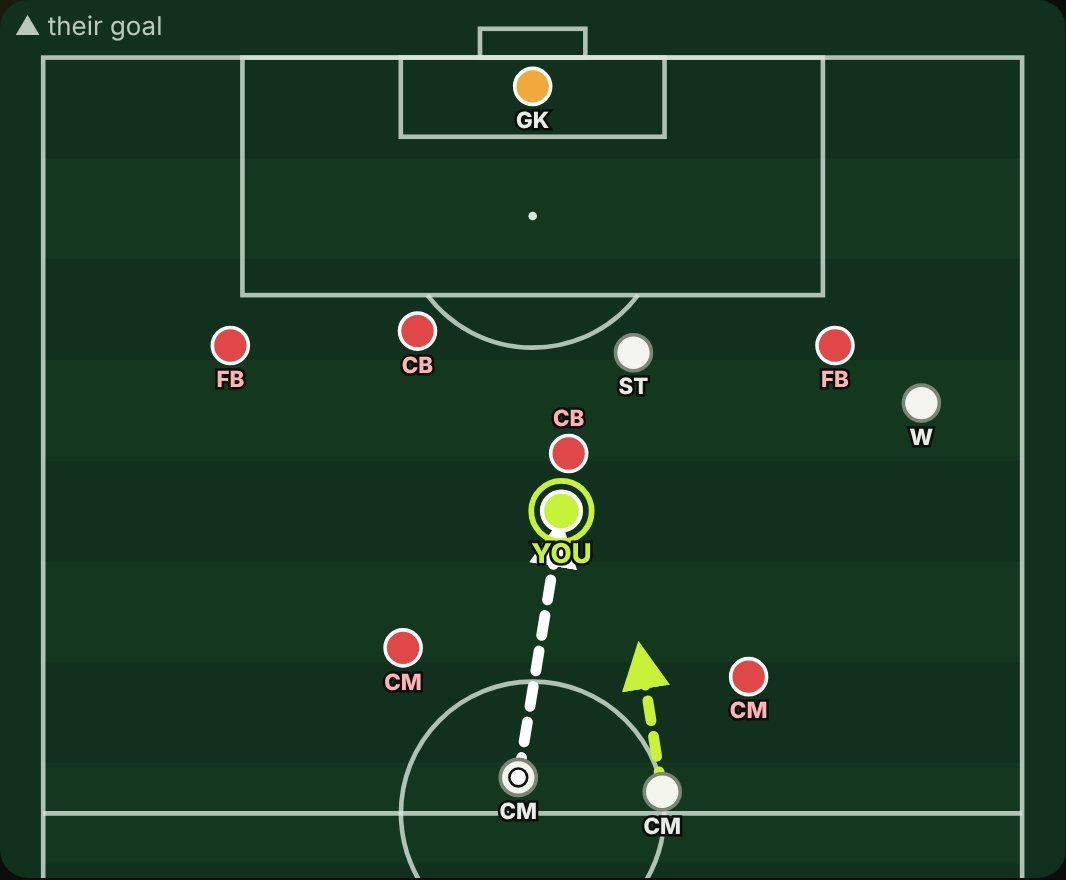
What do you do?
- A Turn and run at their back line.
- B Lay it off first time to your midfielder running up. (pro pick)
- C Shield it and wait for support.
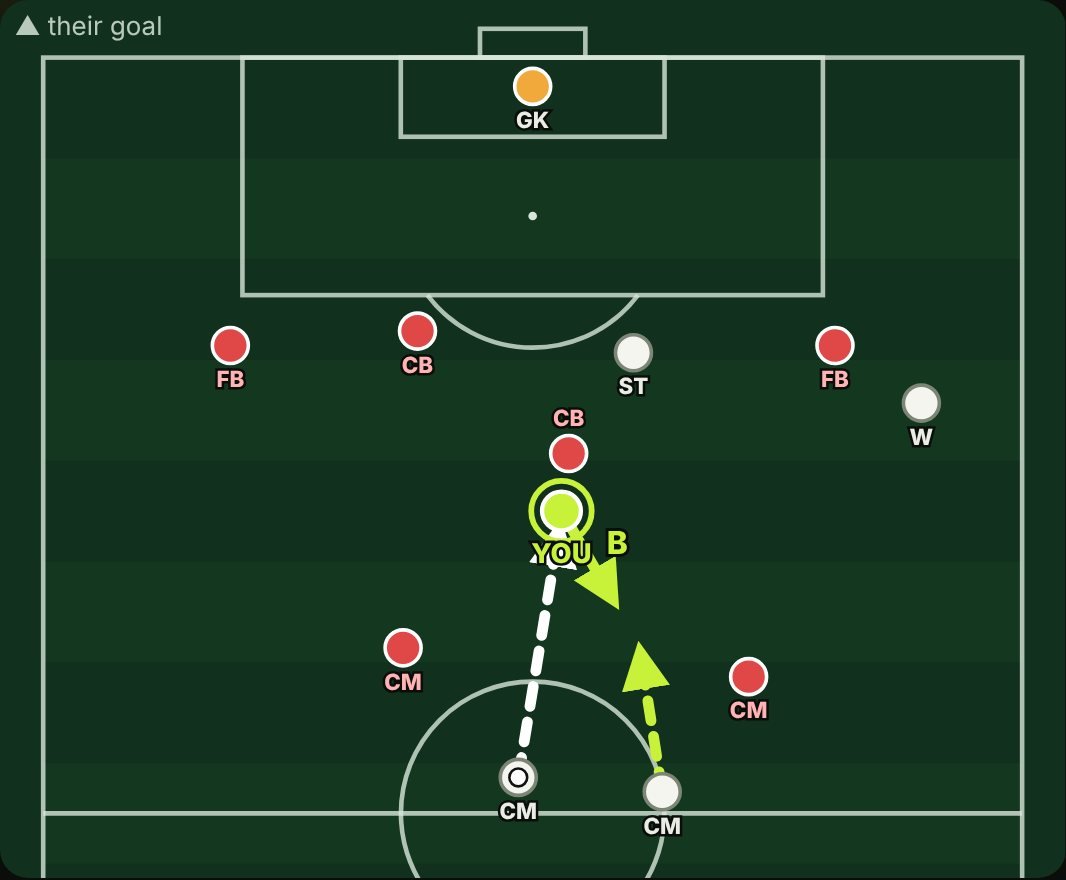
Why B: One of their centre backs has followed you out and is about 4 metres from your back. That means two things. You can’t turn safely, and there is now a gap in their back line where he used to be. Your striker is standing alone in it. You can’t reach him from where you are, but your other midfielder is arriving facing forward. Set it to him first time and he can play it into that gap.
Why not A: Turning is usually what a 10 wants to do between the lines, and if nobody had followed you it would be the right call. With a centre back that close, he takes the ball off you while your team is pushed forward.
Why not C: Shielding keeps the ball for a second or two. That is useful when no help is coming. Here help is already arriving, and every second you hold it lets their midfielders squeeze you from behind.
If you didn’t check your shoulder, you wouldn’t know the centre back was there until he was on you. More situations for this role are in the Number 10 pack.
Situation 3: defender facing a 2v1
You are a centre back. It is 1-1 after 71 minutes. Your corner was cleared and they are breaking. Two of them are coming at you. Your goal is at the top of this board.
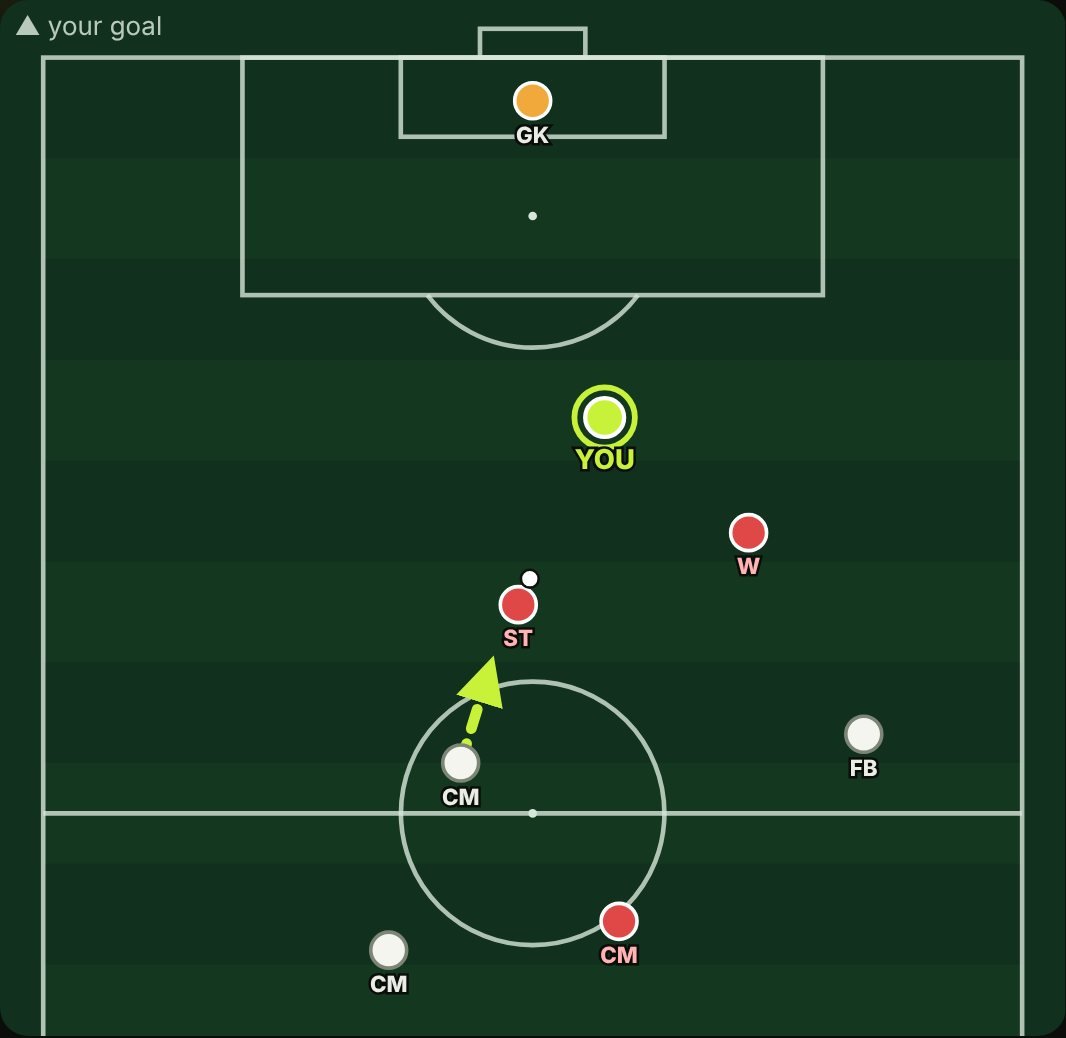
What do you do?
- A Go and close the ball carrier now.
- B Drop off between them and slow it down. (pro pick)
- C Run across with the free runner.
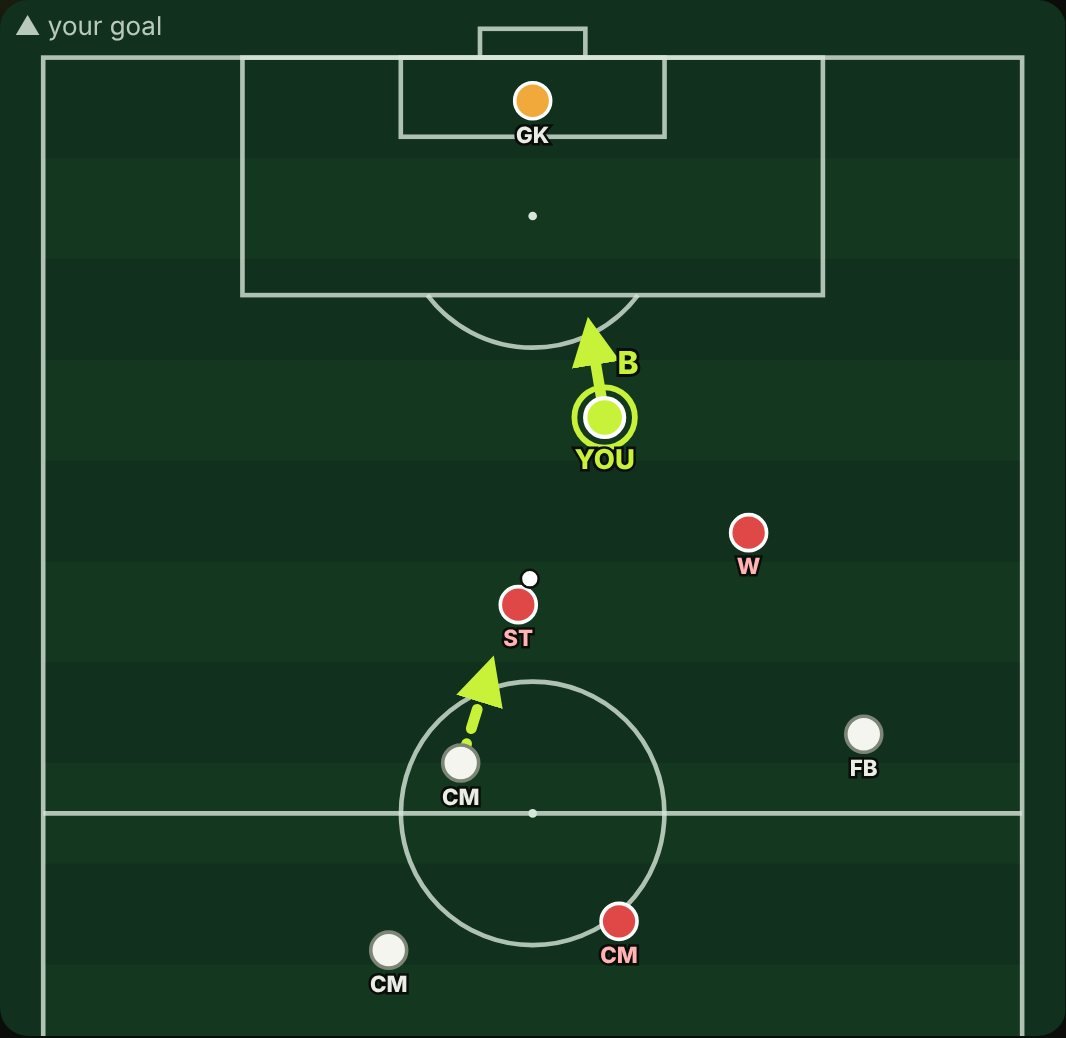
Why B: Look at your midfielder: he is sprinting back and is only a few seconds away. The ball is still nearly 40 metres from your goal, so you have room to give ground. Back off slowly, stay between the ball and the other runner, and make the carrier decide. If he passes, you are close enough to step across. If he keeps going, you are still in front of him. Every second you buy turns a 2v1 into a 2v2.
Why not A: It feels brave, and a lot of players would pick it. But nobody is behind you. The moment you commit, he slips it to the other runner and he is through on your keeper.
Why not C: It cuts out the pass, but gives the ball carrier a straight run at goal. Go with the runner only once the carrier has clearly decided to go alone.
Here the safe-looking option is right, while in Situation 1 the bold one was. That is why rules like “always be positive” don’t work. Defending situations like this are in the Defender pack.
Try 8 more situations like these, free
The free test gives you 8 match pictures and 3 options each, then shows the pro pick and why. No sign-up.
How to train decisions on your own
You can’t practise a 2v1 alone in the park, but you can practise reading it.
1. Work through match situations
Pictures like the three above train the “see it, compare, choose” part without any pressure. Do a few at a time. Before you look at the options, say out loud what you would do and which detail made you choose it. If you got it wrong, find the detail you missed. That is the part that carries into games.
There is some research support for this kind of training. A 2022 systematic review in Frontiers in Human Neuroscience looked at 10 studies of video-based training in football players. In 8 of them, the players who did it performed better on anticipation or decision-making tests than those who didn’t. The authors were careful: they couldn’t run a full meta-analysis and the studies were set up differently, so treat it as “promising”, not “proven”.
2. Watch games with one question
Watching a full match “to learn” usually turns into watching it as a fan. Pick one player in your position and one question for 15 minutes, for example: “When does the winger take his full-back on, and when does he lay it back?” Pause before he receives the ball, guess what he will do, then play it. Our guide to analysing a football match as a player walks through this step by step.
3. Review your own decisions after each match
Straight after a game, write down three moments: one good decision, one bad one, and one you aren’t sure about. For each one, note what you saw and what you missed. If you have video, check it. After a few weeks you will see the same mistake keep coming up. That one mistake is your training plan.
If you want to compare different ways of training game intelligence, such as books, apps, VR and scenario training, see our page on soccer IQ training (in the US the game is called soccer).
A 15-minute daily decision routine
This fits around school, work or your normal training. No equipment needed for the first two blocks.
| Minutes | What you do | Why |
|---|---|---|
| 0–5 | 3 to 5 situations. Decide before reading the options, then check the why. | Trains reading the picture and comparing options. |
| 5–10 | 5 minutes of a real match: follow one player in your position. Pause before each touch and predict. | Shows you how good players solve the same problems. |
| 10–15 | Wall passes with a scan: before each return pass, look over one shoulder and name something you see (a colour, an object, a number on a card a friend holds up). | Builds the habit of looking before the ball arrives. |
Once a week, swap the first block for your match review.
None of this replaces playing. Reading situations helps you see more; real games are where you test it. Use both.
FAQ
Why do I make bad decisions in football?
Usually because you saw the picture too late. If you only look at the ball while it is coming to you, you only find out about the defender behind you or the free teammate when it is too late to use them. Look around before the ball arrives and you will have more options to choose from.
How do pro players decide so fast?
They have usually seen the picture before the ball reaches them, so the decision is already half made. They have also seen thousands of similar situations, so they recognise patterns quickly instead of working everything out from scratch.
How can I make quicker decisions on the ball?
Look over your shoulder while the pass is travelling, decide your first option before the ball arrives, and keep a second option in mind in case it closes. Training with match situations helps you recognise common pictures faster.
Does watching football improve decision making?
It can, if you watch with a purpose. Follow one player in your position, pause before he receives the ball, and predict what he will do. Watching casually as a fan teaches much less.
What is scanning in football?
Scanning means quick looks around you, mostly over your shoulders, before the ball reaches you. It tells you where opponents, teammates and space are, so you can decide what to do before your first touch.
Train the reading part, 20 situations per position
Pause & Decide has 100 match situations like the ones on this page, each with 3 options, the pro pick and the reason. One payment of $27, no subscription.
Sources: The FA Boot Room: How to develop a decision-maker · Zhao et al. (2022), Effects of video-based training on anticipation and decision-making in football players: a systematic review, Frontiers in Human Neuroscience