GUIDE · POSITIONS · STRIKER
Striker in Soccer: What a Striker Does, the 6 Types, and How to Play the Position
What a striker does, the six types with examples, how strikers decide where to run and when to shoot, three tactics-board situations and a weekly plan you can do alone.
Take the football IQ test →Quick answer: A striker in soccer is the attacking player who plays closest to the opponent’s goal, and whose main job is to score. Strikers also run in behind the defense, hold the ball up for teammates and press the other team’s defenders first. They traditionally wear number 9. Unscouted’s guide below covers the six types of striker, how strikers decide where to run and when to shoot, and a weekly plan to train the position on your own.
Key takeaways
- A 4-3-3 has one striker; a 4-4-2 or 3-5-2 has two.
- There are six common types: poacher, target man, complete forward, pressing forward, false 9 and second striker.
- Great strikers win most of their goals before the ball arrives, with the run they choose and when they start it.
- On target beats power. A low, side-foot finish that hits the target is the striker’s most useful shot.
- You can train finishing, movement and decisions alone in 4 short sessions a week.
What is a striker in soccer?
A striker is the forward who plays in the middle of the attack, nearest to the other team’s goal, and whose first job is scoring. Strikers usually stand on or near the opponent’s last defender, so they are the player the team looks for when it wants to go forward quickly or finish a move.
In football (what most of the world calls soccer), the position is also called center forward or “the 9”, because in the old system of shirts 1 to 11 by position the center forward wore 9.
Striker and center forward are used interchangeably today. The fine difference: “center forward” describes where you stand (the middle of the front line), while “striker” describes what you do (finish chances). A false 9, for example, is a center forward who doesn’t behave like a classic striker.
What is the difference between a striker and a forward?
A forward is any player in the front line, so wingers and strikers are all forwards. A striker is the forward who plays centrally, nearest the goal, with scoring as the first job. Every striker is a forward, but not every forward is a striker. Center forward and “the 9” mean almost the same as striker.
| Term | What it means | Where on the pitch |
|---|---|---|
| Forward (attacker) | Umbrella word for every player in the front line | Anywhere across the front |
| Striker | The forward whose main job is finishing chances | Central, closest to goal |
| Center forward | Where you stand: the middle of the front line. Used as a synonym for striker | Central |
| Number 9 | The classic shirt number of the center forward, and a nickname for a striker who stays high and central | Central, on the last line |
| False 9 | A center forward who drops into midfield instead of staying high | Starts central, drops deep |
| Second striker | Plays just behind or beside the main striker, creating and scoring | Between midfield and attack |
| Winger | A wide forward who beats full-backs, crosses and cuts inside | Wide left or right |
So when a coach says “you’re up front”, ask which job he means. A 9 who stays on the last defender plays a different game from a false 9 who drops, or a winger who starts wide.
Where does a striker play on the field?
A striker plays in the middle of the front line, usually level with the other team’s last defender when his team has the ball, and just in front of their center backs when it doesn’t. He moves across the width of the box and into the channels between center back and full-back, but his home is central.
| Moment | Where the striker should be | Why |
|---|---|---|
| Team building from the back | On the last defender, between the two center backs | Pins both center backs so they can’t step into midfield |
| Midfielder facing forward with time | On the shoulder of a center back, ready to spin | The pass in behind is on |
| Ball wide with a winger | In the box, choosing near post, far post or penalty spot | Crosses and cut-backs need a target |
| Passer under pressure | Coming short, back to goal | Gives him an easy pass and a way out |
| Other team has the ball | In front of their center backs, blocking the pass into midfield | Starts the press and protects your midfield |
| Defending a corner | Usually on the edge of the box or halfway line, as the outlet | Ready to start the counter |
Two positioning habits help more than any trick. First, stay inside the width of the penalty box most of the time, so you’re in the right place when the ball goes wide. Second, don’t drift into the crowd around the ball: if two teammates are already close to it, you’re more useful pinning the defense.
What does a striker do in a game?
A striker scores goals, makes runs that stretch the defense, holds the ball up so teammates can join the attack, and starts the team’s press when the other team has the ball. The balance between these jobs depends on the formation and on the type of striker the coach wants.
- Score from crosses, through balls, cut-backs and rebounds.
- Stretch the defense. Runs in behind push their line deeper and open space for your midfielders.
- Hold up and link. Protect the ball with your back to goal and lay it off.
- Press first. You decide which way their build-up goes.
- Attack the box. Pick the right spot for crosses and follow every shot.
| Formation | Strikers | What changes for the striker |
|---|---|---|
| 4-3-3 | 1 central striker, 2 wingers | Often alone against two center backs. Run across them and pin them for the wingers. |
| 4-2-3-1 | 1 striker, a number 10 behind | More hold-up play: lay it off to the 10 and run for the return. |
| 4-4-2 | 2 strikers | Usually one goes short, one goes long. Read your partner. |
| 3-5-2 | 2 strikers | Wing-backs give width; both strikers stay central. |
What are the 6 types of striker?
The six common types are the poacher, the target man, the complete forward, the pressing forward, the false 9 and the second striker. Most real strikers mix two or three. Knowing them shows you which suits your strengths and what to train first.
| Type | What he does | Main skill to train | Well-known examples |
|---|---|---|---|
| Poacher | Lives in the box. Few touches, lots of goals from close range, rebounds and tap-ins. | Movement in the box, first-time finishing | Filippo Inzaghi, Gerd Müller, Javier “Chicharito” Hernández |
| Target man | Tall and strong. Wins long balls and crosses, holds the ball up, brings others into play. | Heading, shielding, lay-offs | Didier Drogba, Olivier Giroud, Peter Crouch |
| Complete forward | Does everything: scores with both feet and head, drops to link play, runs in behind. | All-round finishing and passing | Harry Kane, Robert Lewandowski, Karim Benzema |
| Pressing forward | Hunts defenders and the keeper, forces mistakes high up the pitch, runs all game. | Pressing angles, repeat sprints | Jamie Vardy at Leicester, Roberto Firmino at Liverpool |
| False 9 | Starts as the striker, then drops into midfield to pull center backs out and free space for runners. | Receiving on the half-turn, passing | Lionel Messi under Pep Guardiola at Barcelona, Nándor Hidegkuti for Hungary in the 1950s |
| Second striker | Plays just off a main striker, between midfield and attack. Creates and scores. | Finding pockets of space, final pass | Dennis Bergkamp, Alessandro Del Piero, Antoine Griezmann |
Pick your type by what you already do well, not by height alone. If you like dropping into midfield and creating, read our number 10 guide too; if you drift wide and run at full-backs, the winger guide.
What skills does a striker need?
A striker needs accurate finishing with both feet, a first touch that sets up the shot, smart movement off the ball, the strength to hold the ball up, timing in the air, and the discipline to press. Finishing and movement matter most.
| Skill | What “good” looks like | Test yourself |
|---|---|---|
| Finishing | Low, side-foot, on target. Power comes second. | 20 shots from the penalty spot area: how many hit the target? |
| First touch | The first touch sets up the shot, so the second touch is the shot. | Off a wall: touch, shoot. No third touch allowed. |
| Movement | Runs that start before the pass, timed to stay onside. | Film 10 minutes of a game: count real runs vs runs you only pointed at. |
| Back to goal | Body between defender and ball, quick lay-off or turn. | Wall passes with a cone behind you as the “defender”. |
| Heading | Eyes on the ball, attack it, jump early, contact with the forehead. | Self-toss headers at a target on a wall. |
| Pressing | Curved runs that cut off one pass and push play to one side. | Count how often their center back passed into the middle past you. |
How do strikers stay composed after missing chances?
Strikers stay composed by judging themselves on the chance, not the result. If the run was right and the shot was on target, that’s a good action even if the keeper saved it. A simple reset routine after a miss, plus patience through quiet spells, keeps you shooting with the same technique.
- Reset in one breath. After a miss, breathe out, say one cue word (like “low” or “corner”), and get back onside. The next chance won’t wait for you to stop thinking about the last one.
- Judge the process. After a game, ask three questions: did I get into the box, did I hit the target, did I make the run early? Goals follow those.
- Be patient. A striker can touch the ball only a handful of times in the box in a whole game. Keep making runs in the quiet spells, because one of them will be the chance.
- Pick your corner before the ball arrives. Most rushed finishes come from deciding late. Glance at the keeper as the pass is played.
If this is where you struggle most, the Basics Kit ($47) has a full guide on the mental side.
Do strikers need to be fast or tall?
No. Speed and height help, but they aren’t required. Many top strikers win by timing their runs, finding space in the box and finishing calmly. What every striker needs is a quick first step over 5 to 10 metres and good timing, which you can train. Pick the striker type that fits your body.
- If you’re quick: play on the last defender’s shoulder and attack the space in behind.
- If you’re tall or strong: win headers, hold the ball up and bring midfielders into play.
- If you’re neither: live in the box, move late and finish first time, like a poacher, or drop deep and link play.
How does a striker play in different formations?
The formation decides whether you play alone up front or with a partner, and that changes your job. A lone striker has to hold the ball up and stretch the whole back line. In a pair, one striker usually runs in behind while the other drops or plays off him.
| Formation | Strikers | What changes for you |
|---|---|---|
| 4-3-3 | One central striker with a wide forward each side | Stay central, pin the center backs, attack crosses from the wingers |
| 4-2-3-1 | One striker with a number 10 behind | Hold the ball up for the 10, make runs that open space for him |
| 4-4-2 | Two strikers | Split the jobs: one runs in behind, one comes short. Stay close to your partner |
| 3-5-2 | Two strikers with wing-backs | Lots of crosses from wide: one attacks the near post, one the far post |
If your coach plays a number 10 behind you, read our number 10 guide to know what he wants from your runs.
How does a striker decide where to run and when to shoot?
A striker decides by reading three things before the ball arrives: whether the passer has time, where the space is behind or beside the defenders, and where the keeper and nearest defender stand. Most goals are decided by the run chosen a second or two before the pass.
Movement before the ball
Time your run off the passer. If he is facing forward with nobody close, he can play the ball in behind, so go. If he is under pressure or facing his own goal, come short and help him. A small step towards the ball first drags the center back with you.
Playing on the shoulder (and the offside line)
“On the shoulder” means standing level with the last defender, on his blind side, ready to spin in behind. Under Law 11 of the official Laws of the Game, you are onside if you are level with the second-last opponent (usually the last outfield defender), and you can’t be offside in your own half or from a throw-in, goal kick or corner. Your head, body and feet count; your arms don’t. Curve your run along the line so you stay onside until the pass is played.
Near post or far post?
Before a cross, count the bodies. Near post empty: attack it early. Keeper and defenders crowding the near post: go far post. Winger on the byline and defenders dropping onto the goal line: stop at the penalty spot for the cut-back.
Shoot or pass?
- Shoot if you can hit the target and no defender is in the shooting lane.
- Pass if a teammate has a clearly better chance and the passing lane is open.
- If the defender sits in the passing lane, the shot is usually on. If he blocks the shot, the pass usually is.
- Don’t take an extra touch to “get closer” with a defender recovering behind you.
Pressing triggers
Curve your run to cut off the pass into the middle, then sprint on a trigger: a back pass, a bad first touch, a center back receiving facing his own goal, a pass out to the full-back near the touchline, or the keeper receiving on his weaker foot. Our decision-making training guide shows how to practise reading cues.
What does a striker decide in real match situations?
Look at each board, pick A, B or C, then check the pro pick. You are the lime player; their goal is at the top.
Situation 1: your midfielder has the ball, you’re on their back line
It is 0-0 after 15 minutes. Your central midfielder has the ball just inside their half. You’re on their back line.
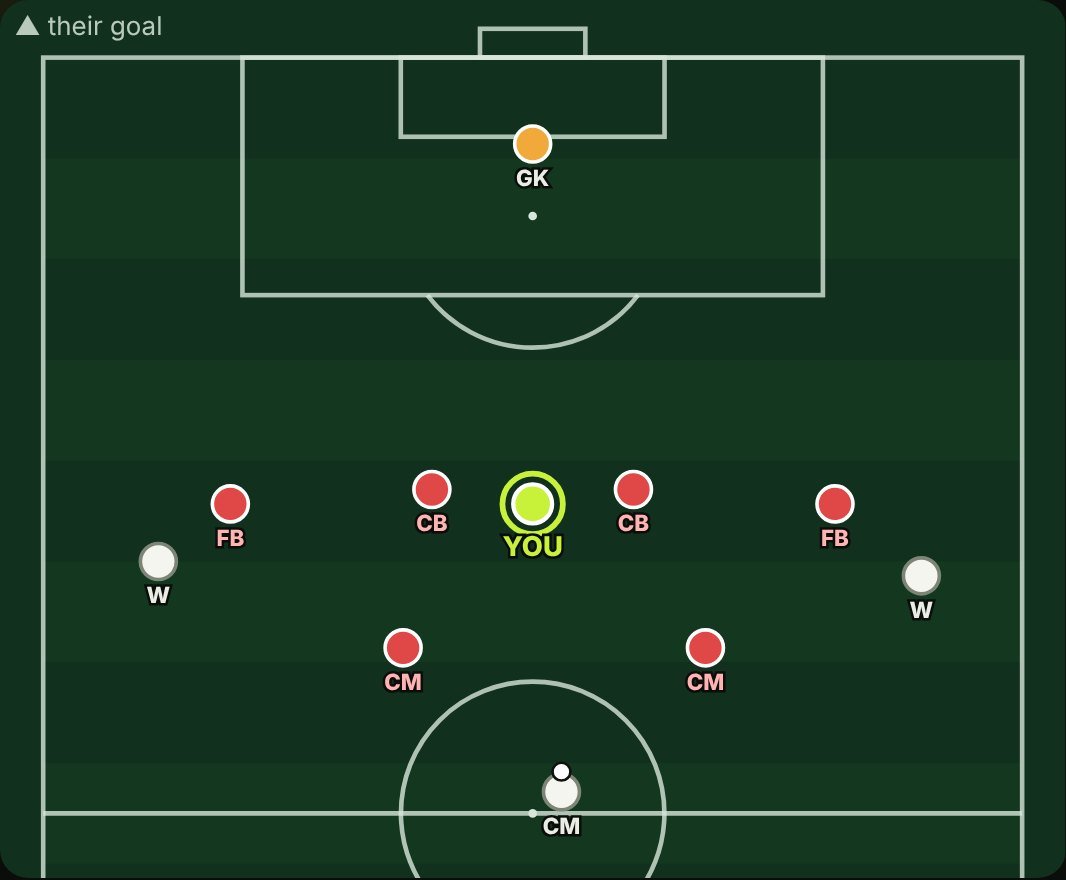
What do you do?
- A Come short towards him for the ball.
- B Stay between the center backs and call for it.
- C Curve across the left center back and run in behind. (pro pick)
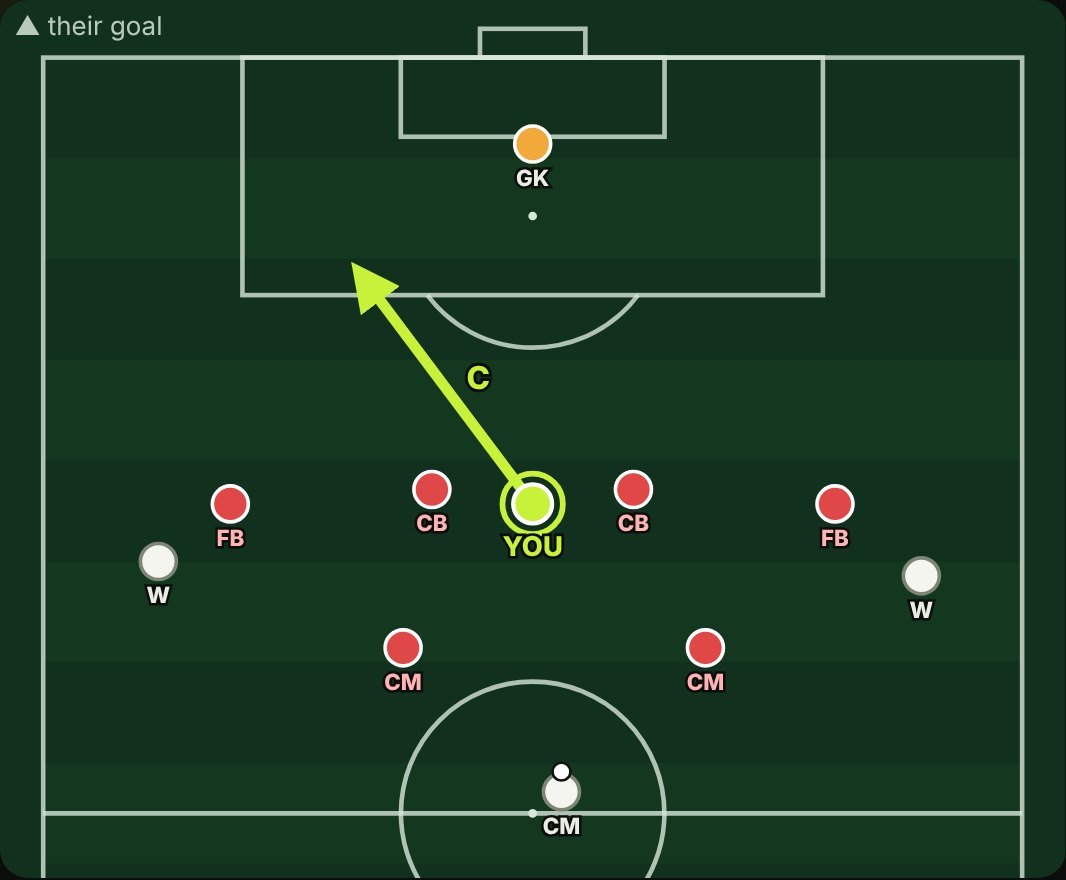
Why C: The passer faces forward with nobody near him, and there are about 20 meters of empty grass behind their line. Curve your run so the center back loses sight of you. Why not A or B: coming short is for when the passer is under pressure, and standing still is easy to mark.
Situation 2: a cross is coming from the left
It is 1-1 after 60 minutes. Your left winger is about to cross from the left. You’re arriving in the box.
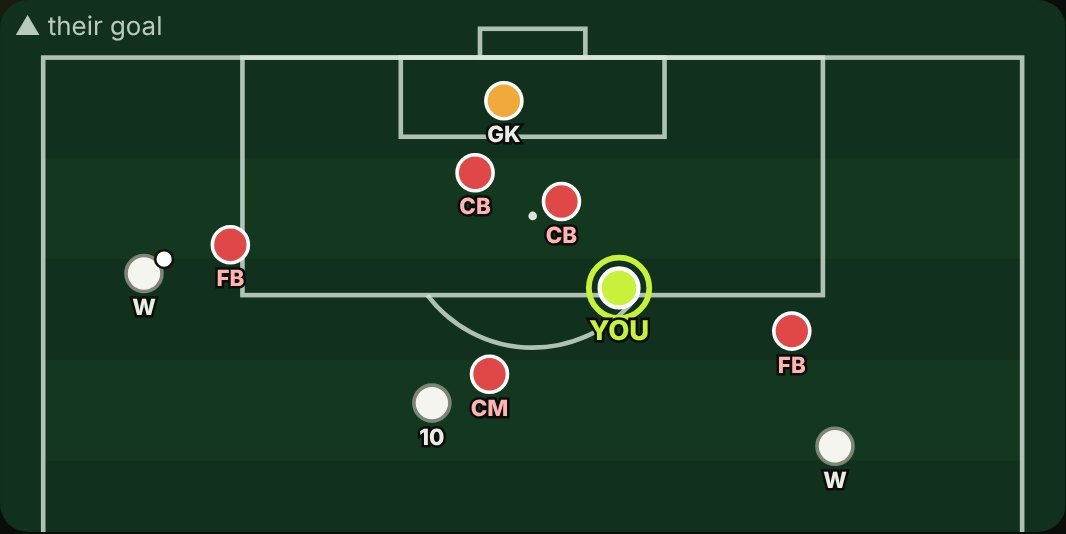
Where do you run?
- A Attack the near post.
- B Run to the far post. (pro pick)
- C Hold your spot near the penalty spot.
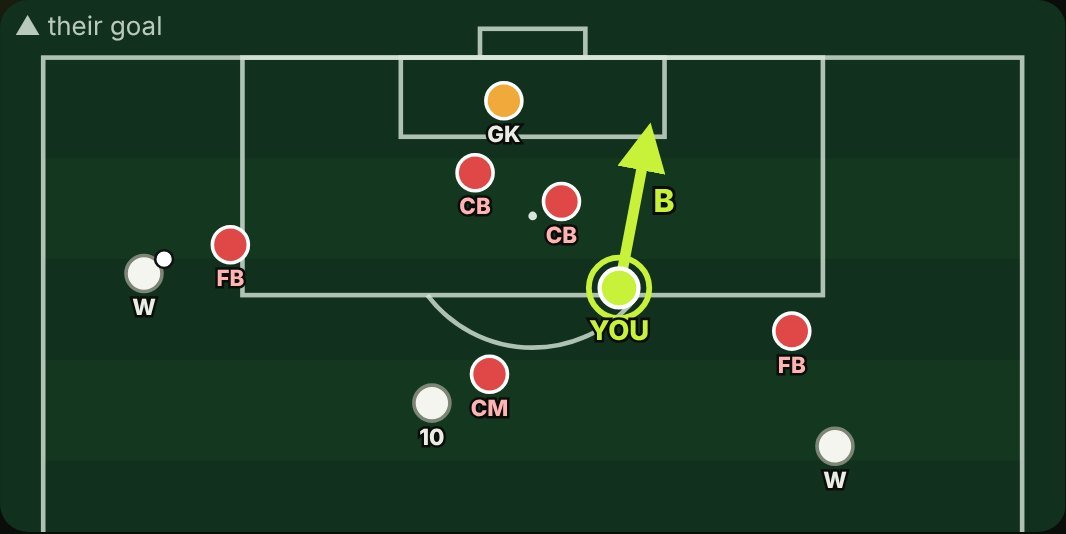
Why B: Their right back is still near the edge of the box, more than 15 meters from the far post, so nobody guards it. Why not A or C: the keeper and a center back already fill the near post, and the penalty spot suits a low cut-back from the byline, not a cross from this deep.
Situation 3: shoot or square it?
It is 0-0 after 78 minutes. Counter attack. You’ve carried it into the right side of the box. A teammate is running with you on the left.
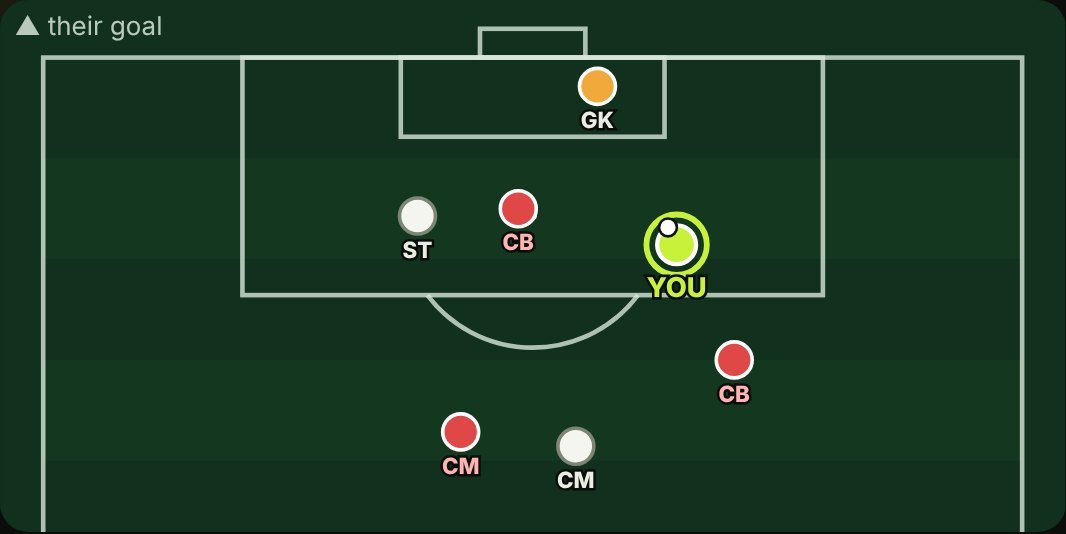
What do you do?
- A Shoot low across the keeper into the far corner. (pro pick)
- B Square it to your teammate.
- C Take one more touch to get closer.
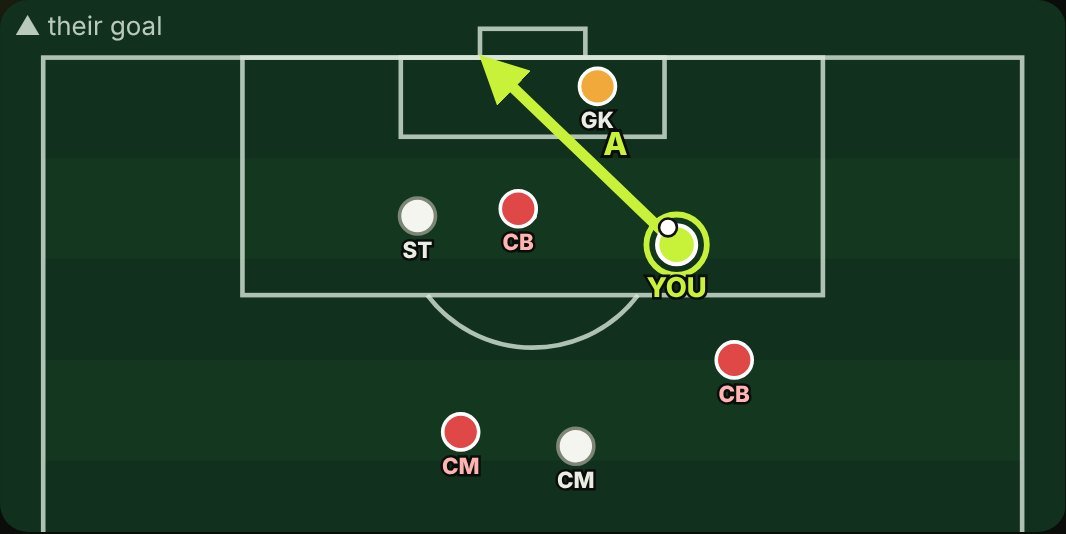
Why A: Their center back has stepped into the passing lane, not the shooting lane, and the keeper is guarding his near post. Shoot low, now. Why not B or C: the square pass runs straight into the center back, and an extra touch lets the recovering defender catch you.
In all three, the answer came from one detail you could only see by looking early. That’s why strikers need to scan too, even though forwards scanned the least in a well-known study of Premier League players.
Go deeper with the Striker Pack
A striker’s code from studying Haaland, Kane, Henry and Ronaldo (finishing, movement, back to goal, pressing, set pieces), four finishing sessions and worksheets. One payment of $17.
How do you play striker in your next game?
To play striker well in your next game, check the defense before kick-off, stay on the last defender, time each run off the passer, choose your spot before every cross, shoot low and on target, and press their center backs with curved runs. These six steps turn the ideas on this page into a routine.
- Read their back line in the warm-up and first 5 minutes. Which center back is slower? Do they hold a high line or drop? That tells you whether to run in behind or come short.
- Start on the last defender. Stand between or on the shoulder of their center backs, on the blind side, inside the width of the box.
- Time every run off the passer. Passer facing forward with time: go in behind. Passer under pressure: come short and help him.
- Pick your spot before each cross. Count the bodies at the near post, far post and penalty spot, and go where nobody is.
- Finish low and on target. Pick the corner before the ball arrives and side-foot it. Then follow every shot, yours or a teammate’s.
- Press with curved runs. Cut off the pass into midfield and sprint on a trigger: a back pass, a bad touch or a pass out to the full-back.
What is a good weekly striker training plan?
A good striker week has two finishing sessions, one movement and speed session, one session with a friend, and time watching a striker. Keep sessions to 45–60 minutes and count only shots on target.
| Day | Session | What to do | Time |
|---|---|---|---|
| Mon | Finishing 1 (alone) | Pass to a wall, first-time side-foot finishes into each corner, both feet. Score 10 on target per drill before moving on. | 45 min |
| Tue | Movement and speed | 10 × 15 m sprints with a check step first. Curved runs around a cone “center back”. Double movement: two steps short, then spin. | 40 min |
| Wed | Rest or team training | With team training, focus on one thing: time every run off the passer. | – |
| Thu | Finishing 2 (alone) | Two-touch rule: first touch sets the ball, second touch is the shot. Turn-and-shoot both ways. Self-toss volleys. | 45 min |
| Fri | With a friend | Crosses and cut-backs: he rolls or crosses, you finish first time. Then back to goal: he passes into you, plays as defender, you lay off or turn. | 50 min |
| Sat | Game | Pick one thing to do on purpose, like following every shot. | Match |
| Sun | Watch and decide | Study a striker on TV, plus 10 minutes of decision practice. | 30 min |
Track one number each week: your percentage of shots on target. For a full-season structure around this, see our soccer training plan.
Which famous strikers should you study, and how?
Study the striker whose type is closest to yours, not simply the most famous one. Gerd Müller and Filippo Inzaghi show box movement, Didier Drogba hold-up play, Thierry Henry runs from the channel, Ronaldo Nazário dribbling and 1v1 finishing, and Harry Kane how a complete forward drops and passes.
| Striker | Type | What to watch for |
|---|---|---|
| Gerd Müller (West Germany) | Poacher | Quick, short movements in the box and finishes with any part of the body |
| Filippo Inzaghi (Italy) | Poacher | Living on the offside line and arriving at the right moment for rebounds |
| Ronaldo Nazário (Brazil) | Complete forward | Running at defenders with the ball and calm finishes when 1v1 with the keeper |
| Thierry Henry (France) | Complete forward | Drifting into the left channel, then side-foot finishes across the keeper |
| Didier Drogba (Ivory Coast) | Target man | Shielding long balls, bringing midfielders into play, attacking crosses |
| Jamie Vardy (England) | Pressing forward | Leicester’s 2015–16 title season: pressing and early runs in behind |
| Harry Kane (England) | Complete forward | Dropping deep to pass for runners, then arriving in the box |
| Erling Haaland (Norway) | Number 9 / runner | Runs across the center back’s blind side and first-time finishes |
We name national teams, not clubs, because players move. Watch full matches or extended highlights; a goals compilation skips the runs that made each goal.
How to study one: watch the striker, not the ball, for 10 minutes at a time. Note what he does before the ball reaches him. Highlights never show that part.
- Runs: how many in behind, how many short, how many across a defender?
- Crosses: where does he stand before the cross, and when does he move?
- First touch: does it go away from the defender, or set up a shot?
- Shots: how many first time, how many low, how many on target?
- Pressing: who does he press, from which side, and what makes him sprint?
Write three things to steal and try one next session. Our guide on analysing a match as a player has the full method. Strikers scan less than any other position, so check yours with the free football scanning test, and if you’re aiming to get noticed, read how to get scouted for soccer.
What are the most common striker mistakes?
The most common striker mistakes are shooting for power instead of the target, standing still, running offside, pointing at space without running, and stopping after a teammate shoots.
- Blasting it. A hard shot over the bar is worth nothing. Low and on target first.
- Standing still. Keep making runs, even when the ball doesn’t come.
- Pointing, not running. A run you only point at doesn’t exist for the passer. If you see it, go.
- Drifting offside. Get back level early and quietly, then go again.
- Not following shots. Every time a teammate shoots, run at the goal for the rebound.
- Forcing it with your back to goal. If you can’t turn, lay it off or win the foul.
Want to be seen up front? Read our guide to pro soccer tryouts, and the center back guide to see the game from the defenders’ side.
Train your striker decisions
Pause & Decide has 100 situations, 20 for strikers. The Striker Pack has the full striker’s code and finishing sessions.
FAQ
What is a striker in soccer?
A striker is the forward who plays closest to the opponent’s goal, in the middle of the attack. Their main job is scoring, and they also run in behind, hold the ball up and press first.
What number does a striker wear?
Traditionally number 9, from the old system where shirts 1 to 11 matched positions. Second strikers often wear 10, and with squad numbers today a striker can wear any number.
What is the difference between a striker and a center forward?
Today they mean almost the same thing and are used interchangeably. “Center forward” describes where you play, the middle of the front line, while “striker” describes the job of finishing chances.
What does a striker do when the team doesn’t have the ball?
The striker presses first. He curves his run to cut off the pass into the middle, pushes their build-up to one side, and sprints on triggers like a back pass or a bad touch.
What is a false 9?
A false 9 starts as the striker but drops into midfield to get the ball. That pulls center backs out of position and opens space for wingers and midfielders to run into. Lionel Messi played the role under Pep Guardiola at Barcelona.
Do you have to be tall or fast to be a striker?
No. Height helps a target man and pace helps a runner, but poachers and false 9s win with timing, movement and first touch. Pick the type of striker that fits what you already do well.
How can I become a better striker on my own?
Do two finishing sessions a week where only shots on target count, one movement and speed session, and study a striker on TV. Practise decisions too, for example with Unscouted’s free soccer IQ test.
Do strikers need to be fast?
No. Speed helps for runs in behind, but many strikers score through timing, movement in the box and calm finishing. A quick first step over 5 to 10 metres matters more than top speed, and you can train it.
What is the difference between a striker and a forward?
A forward is any player in the front line, including wingers. A striker is the forward who plays centrally, closest to goal, with scoring as the first job. Every striker is a forward, but not every forward is a striker.
Where should a striker stand?
In the middle of the front line, usually level with the other team’s last defender when your team has the ball, and inside the width of the penalty box when the ball is wide. Come short when the passer is under pressure, and run in behind when he faces forward with time.
Sources: IFAB, Laws of the Game, Law 11: Offside (checked October 2026) · Wikipedia, Forward (association football): number 9, target man, false 9 and second striker · Jordet et al. (2020), scanning in Premier League players, Frontiers in Psychology