POSITION GUIDE · NUMBER 10
The Number 10 in Soccer: What It Means, Famous 10s, and How to Play the Role
What the number 10 means, the famous 10s, and the part other guides skip: how a 10 decides, with three match situations and a plan you can train alone.
Take the free soccer IQ test →Quick answer: In soccer, the number 10 is the attacking midfielder who plays in the space between the other team’s midfield and defense and creates chances with passes, dribbles and shots. The name comes from the shirt number: in the old 2-3-5 formation, 10 was the inside left forward, and great playmakers like Pelé and Maradona made it the star’s shirt. Today the role is about decisions more than the shirt, and Unscouted’s free soccer IQ test lets you practise those decisions in real match pictures.
Key takeaways
- “Number 10” means two things: a shirt number and a position (the attacking midfielder, playmaker or “enganche”).
- A 10 is a midfielder by position but plays like a half forward: the job is the final third.
- In a 4-2-3-1 the 10 plays central behind the striker. In a 4-3-3 the role is often split between two “free 8s” in the half-spaces.
- What makes a good 10 is mostly decisions: finding the gap, scanning before the ball arrives, turning or setting it back, and picking the right final pass.
- You can train most of it alone or with one friend: a wall, a few cones and game footage.
What does number 10 mean in soccer?
In soccer, “number 10” means the attacking midfielder: the player who sits behind the striker, between the opponent’s midfield and back line, and turns possession into chances. It is also the shirt number that this player traditionally wears, which is why both meanings get mixed up. On the field, the position matters more than the shirt.
You will hear other names for the same job: playmaker, attacking midfielder, “the hole”, the enganche (Argentina and Uruguay) and the trequartista (Italy, roughly “three-quarter player”). In football (what most of the world calls soccer), the role has the same reputation everywhere: the 10 is the team’s creative player, the one who is expected to make something happen.
A quick way to see it: the 6 protects, the 8 runs box to box, the 9 scores, and the 10 creates, mostly from the space just outside the opponent’s box.
Where does the number 10 come from?
The number 10 comes from early shirt numbering, where numbers matched positions. In the 2-3-5 formation, 10 was the inside left forward. As formations changed, that player dropped into the space behind the striker, and the shirt went with him.
| Year | What happened |
|---|---|
| 1928 | First recorded shirt numbers in Europe, 25 August 1928 (Sheffield Wednesday v Arsenal, Chelsea v Swansea Town). Numbers follow positions; the inside left wears 10. |
| 1939–40 | The English Football League makes shirt numbers compulsory. |
| 1950 | The first FIFA World Cup where players wear squad numbers. |
| 1958 | Brazil’s federation forgets to send its number list, an official hands them out, and 17-year-old Pelé gets 10. |
| 1980s–2000s | Maradona, Zico, Platini, Baggio, Zidane, Totti and Riquelme make 10 the creative star’s shirt. |
| Today | Fixed squad numbers: top creators often wear other numbers. |
What are the versions of the number 10 role?
There are five common versions of the number 10: the classic playmaker, the trequartista, the shadow striker, the free 8 in a 4-3-3, and the false 9 who drops into the 10 space. They share one area but do different jobs, so first find out which version your coach wants.
| Version | Where | Main job | Formation | Classic example |
|---|---|---|---|---|
| Classic 10 / enganche | Central, behind the striker | Receive between the lines, set the tempo, play the final pass | 4-2-3-1, 4-3-1-2 | Riquelme |
| Trequartista | Free to roam behind the forwards | Create with few defensive duties | 4-3-1-2, 3-4-1-2 | Totti, Baggio |
| Shadow striker | Just behind and beside the 9 | Run beyond, arrive in the box, score | 4-2-3-1, 4-4-1-1 | Thomas Müller (the “raumdeuter”) |
| Free 8 (half-space 10) | Left or right half-space | Receive between the lines from wider, combine with the winger | 4-3-3 | Kevin De Bruyne at Manchester City |
| False 9 | Starts as striker, drops into the 10 space | Pull a center back out and leave space behind | 4-3-3 | Messi at Barcelona |
Is a number 10 a midfielder or a forward? By position, a midfielder: the 10 is the most advanced of the midfield. By job, half a forward: most of what a 10 is judged on happens in the final third. If your team plays a 4-3-3 with no central 10, the 10’s work is usually done by the two 8s and the winger who cuts inside.
How is a number 10 different from a number 8 or a false 9?
All three can end up in the space between the opponent’s midfield and defense, but they start in different places and have different jobs. The 10 starts there and lives there. The 8 is a box-to-box midfielder who arrives there from deeper. The false 9 starts as the striker and drops into it.
| Number 10 | Number 8 | False 9 | |
|---|---|---|---|
| Starts | Between the lines, behind the striker | Central midfield, beside or ahead of the 6 | As the center forward |
| Main job | Create chances: final pass, dribble, shot | Carry the ball forward, link defense and attack, cover ground | Drop deep to pull a center back out and open space behind |
| Defending | Presses their 6 and blocks passes into midfield | Defends a lot, both boxes | Presses their center backs or 6 |
| Italian name | Trequartista | Mezzala (when it plays wide of center) | Falso nueve (Spanish) |
If you’re more of a finisher than a creator, read our striker guide. If you drift wide, the winger guide fits better.
Which formations use a number 10, and is the role dying out?
The classic 10 plays in a 4-2-3-1, a 4-3-1-2 diamond or a 3-4-1-2, where one player sits behind the strikers. In a 4-3-3 there’s often no pure 10: the job is shared by two attacking 8s and the wide forwards. The role hasn’t died, it has spread out, and teams still play a 10 when they want one player to unlock deep defenses.
| Formation | Is there a 10? | What the role looks like |
|---|---|---|
| 4-2-3-1 | Yes | Central of the three behind the striker, protected by two holding midfielders |
| 4-3-1-2 (diamond) | Yes | Tip of the diamond, feeding two strikers |
| 3-4-1-2 or 3-4-2-1 | Yes, sometimes two | One or two 10s between the lines behind the forwards |
| 4-3-3 | Not usually | Two attacking 8s share the 10’s job, arriving in the pockets |
| 4-4-2 | Rarely | A second striker who drops off sometimes plays like a 10 |
Why would a coach still pick a 10? Against a deep, compact defense, the team needs someone who receives between the lines, turns and plays the final pass. The modern 10 has to press and work harder than the classic version, but the creative job is the same.
Who are the most famous number 10 soccer players?
The most famous number 10 soccer players are Pelé, Diego Maradona, Zico, Michel Platini, Roberto Baggio, Zinedine Zidane, Francesco Totti, Juan Román Riquelme and Lionel Messi, plus Marta in the women’s game. Each shows a different way to play the role.
| Player | Known for wearing 10 for | What to study |
|---|---|---|
| Pelé | Brazil, Santos | Scoring from the 10 position. Got the shirt at the 1958 World Cup. |
| Diego Maradona | Argentina, Napoli | Dribbling to pull defenders in, then releasing. Captained Argentina to the 1986 World Cup. |
| Zico | Brazil, Flamengo | Free kicks and the final pass. |
| Michel Platini | France, Juventus | A goal-scoring 10 who arrived late in the box. |
| Roberto Baggio | Italy | Running with the ball between the lines. |
| Zinedine Zidane | France | Close control and turning under pressure. Won the 1998 World Cup. |
| Francesco Totti | AS Roma | First-time passes and vision. |
| Juan Román Riquelme | Boca Juniors, Argentina | The classic enganche: slowing the game down and controlling tempo. |
| Lionel Messi | Barcelona, Argentina | The modern 10 who is also the top scorer. Won the 2022 World Cup. |
| Marta | Brazil | Dribbling and finishing from the 10 area. The all-time top scorer at Women’s World Cups. |
Modern creators often wear other numbers: Kevin De Bruyne wore 17 at Manchester City, Andrés Iniesta wore 8 at Barcelona. For the US men’s team, Christian Pulisic wore 10 at the 2022 World Cup. Study 10s by role, not by shirt.
What skills does a number 10 need?
A number 10 needs a clean first touch on the half-turn, passing with both feet, the ability to protect the ball in tight spaces, a shot from 16–20 meters, and above all fast, good decisions. Technique gets you the ball between the lines; decisions decide what happens next.
- Receiving on the half-turn: body open, ball on the back foot, first touch forward.
- Protecting the ball: body between defender and ball before you try anything.
- Passing: firm, inside of the foot, both feet, one or two touches; through balls, one-twos, cut-backs, switches.
- Shooting from distance: low and accurate from the edge of the box, released quickly.
- Scanning: knowing what is behind you before the ball arrives (see how to scan in soccer).
How does a number 10 decide what to do?
A good number 10 decides before the ball arrives: find a gap between the lines, scan to see who is behind you, and know already whether you will turn, set it back or play first time. Facing forward, you pick the through ball, the switch or the shot based on what the defense gives you.
1. Find the pocket, then keep moving
A pocket is a gap between their midfield and defense where no defender can step to you without leaving his job. Stand in the passing lane, not behind an opponent. If the ball isn’t coming, move: drift to the blind side of their holding midfielder, or drop deeper if their lines are squeezed together.
2. Scan twice before you receive
Look over both shoulders while your teammate is preparing the pass and once while it travels. You are looking for one thing first: how close is the nearest defender, and from which side.
3. Turn only when the scan says yes
- Nobody within about 3–4 meters behind you: open up and turn.
- Defender tight, and he is on one shoulder: roll him on the other side.
- Defender tight and square behind you: set it back first time to a teammate facing forward, and spin off for the return.
4. Pick the final pass by what the defense gives you
| What you see | Best option |
|---|---|
| A runner and a gap between center back and full-back | Through ball into the space in front of him |
| Their back line deep, a clear lane to goal | Shoot from the edge of the box |
| Everyone shifted to your side, far winger alone | Switch it yourself |
| A defender steps out to you | Play into the space he left |
| Nothing on, you are closed down | Keep it: set back and go again |
5. Press on triggers, not all the time
Don’t chase every pass. Go hard on a trigger: a pass to a player facing his own goal, a bad touch, a back pass, a pass towards the touchline. The rest of the time, block the lane into their holding midfielder.
What would you do as the number 10 in these situations?
Decide before you read the answer. You are the lime player; their goal is at the top.
Situation 1: back to goal between the lines
It is 0-0 after 30 minutes. Your left midfielder plays it into you between their lines. You have your back to their goal.

What do you do?
- A Turn and drive at their back line.
- B Set it back first time to your right midfielder. (pro pick)
- C Take a touch and shield it.

Why B: Their DM is tight on your back. Your right midfielder is free, facing forward, nobody within 10 meters. One touch back and he plays forward with time while their DM is stuck behind you. Spin off for the return.
Why not A: Turning is right when nobody is behind you. Here you turn straight into their DM.
Why not C: Shielding is the call when no teammate is free. Here one is, and every second you hold it their other midfielder gets closer.
Situation 2: the final pass
It is 0-0 after 62 minutes. You have the ball facing forward, 25 meters out in the left half-space. Your striker and both wingers are up, and your left winger is starting a run.

What do you do?
- A Shoot from 25 meters.
- B Switch it to your right winger.
- C Slide it into the channel for your left winger’s run. (pro pick)
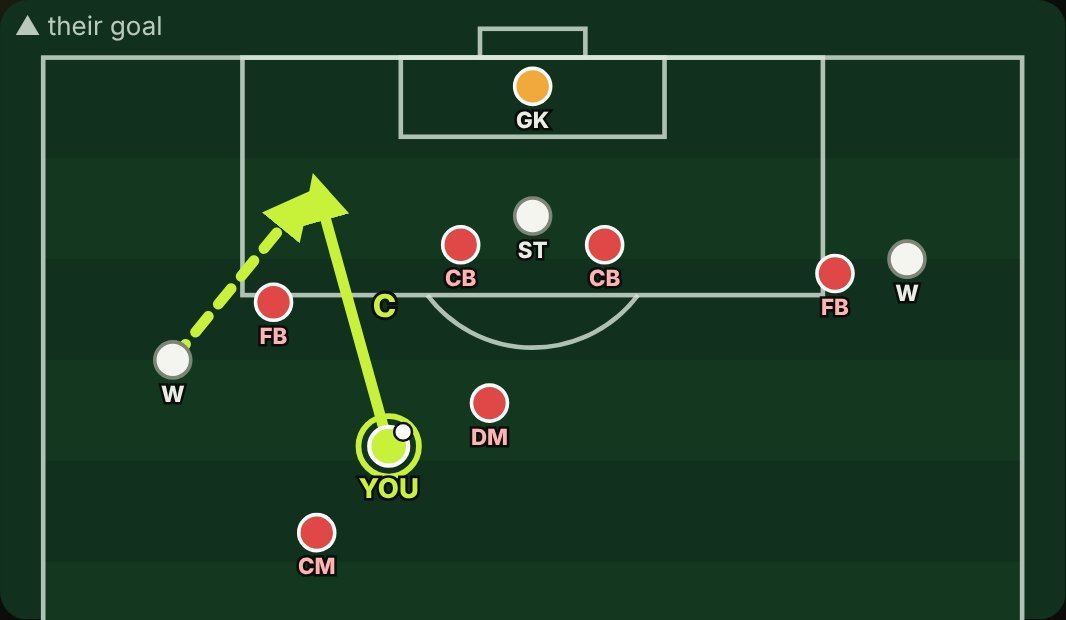
Why C: The gap between their right full-back and center back is more than 12 meters, and your winger is running into it from behind the line, so he is onside. Play it into the space in front of him, not to his feet.
Why not A: A shot is a good answer when the lane is clear. Here their center back stands right in it.
Why not B: The switch is right when the far full-back has tucked in. Here he is about five meters from your winger, so the ball travels a long way and the 1v1 is still waiting.
Want the full number 10 playbook?
The Number 10 Pack goes deeper: the number 10’s code from the playmakers we studied (finding space, receiving, the final pass, shooting from distance, defending), long-shot reps, and player-by-player breakdowns. $17, one payment.
Situation 3: pressing as a 10
It is 0-0 after 20 minutes. They are building from the back. Their center back passes into their midfielder in front of you.

What do you do?
- A Press him from behind as the ball arrives. (pro pick)
- B Step across to their other midfielder.
- C Drop back to protect the space behind you.
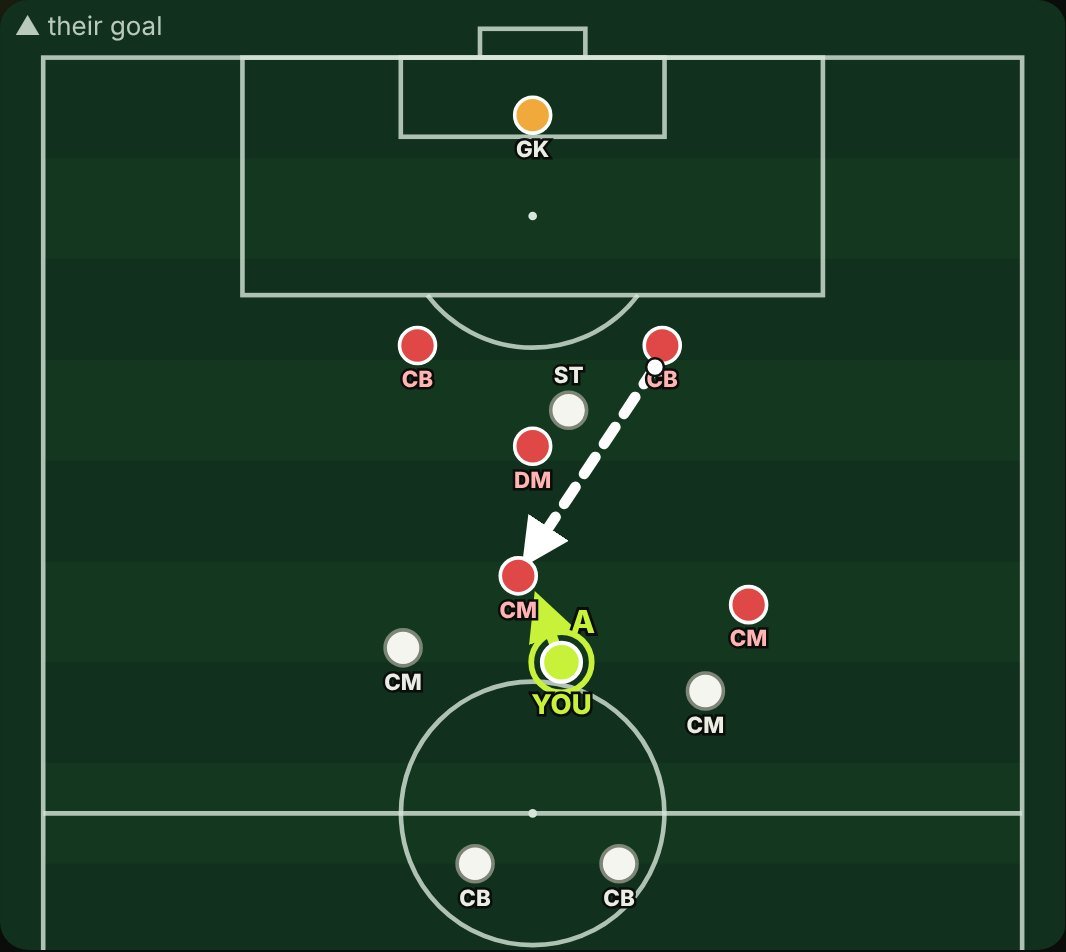
Why A: A pressing trigger. He is coming towards his own center back, so he receives facing his own goal. Your left midfielder closes one side and your striker covers their DM, so there is no easy bounce pass. Arrive with the ball and he goes backwards or loses it.
Why not B: Your right midfielder is already on that player. Leave and you give the man on the ball time to turn into the space you left.
Why not C: Right when the receiver is facing forward. Here dropping gives him time to turn instead of forcing him backwards.
More moments like these for every position are in Pause & Decide: 100 Situations ($27), and the thinking behind them is in decision-making training.
How do you train as a number 10 alone?
You can train most of the number 10’s game alone with a wall, a ball and a few cones: receiving on the half-turn, both-foot passing, tight control and shooting from the edge of the box. Add one video session a week for decisions. Three or four sessions of 30–45 minutes fits next to team training.
| Day | Session | Time | Alone or with a friend |
|---|---|---|---|
| Mon | Wall receiving: pass, shoulder check, receive on the back foot, turn. 5 x 10 each foot. | 30 min | Alone |
| Tue | Team training or rest | – | – |
| Wed | 5×5 meter box: ball mastery and spins, then “turn or set back”: a friend passes in and shouts “man on” or “turn”. | 40 min | Friend (or alone with a cone as the defender) |
| Thu | Team training or rest | – | – |
| Fri | Shooting from 16–20 meters: ball still, then rolling with one touch to set. Only shots on target count. | 30 min | Alone |
| Sat | Match | – | – |
| Sun | Watch one half of a 10, pausing each time he receives. | 45 min | Alone |
Honest caveat: solo work builds technique and habits, but decisions only become automatic in games. Take one rule from this page into each match and check afterwards whether you did it.
The Basics Kit has a 12-week plan, and the Number 10 Pack adds 10-specific long-shot reps. To build this into a full week, use our individual soccer training plan, and check how much you see before the ball arrives with the free football scanning test.
How do you analyze a number 10 on TV?
To analyze a number 10 on TV, watch the player, not the ball, for one half. Every time he receives between the lines, pause, decide what you would do, then press play and compare with what the pro did.
- Before he gets it: where does he stand, and does he scan?
- When it arrives: pause. Turn, set back, first time or shoot? Say it out loud.
- Press play: what did he do, and what did he see that you didn’t?
- Without the ball: when does he press, and when does he just block a lane?
- Write down one thing to copy in your next game.
Full method: how to analyze a match as a player. If you want games picked for you, the Game Library has 84 pro games with notes to compare against.
What are the most common number 10 mistakes?
The most common number 10 mistakes are standing still between the lines, receiving without scanning, dribbling into a crowded middle, holding the ball until the lane closes, and switching off after losing it. Almost all are decisions, not technique.
- Hiding behind a defender. If he is between you and the ball, you aren’t available. Move a few meters.
- Receiving square and blind. Scan, then open up so you can see the field.
- Dribbling into traffic. In a crowded middle, a one-two beats a dribble.
- Releasing too late. The best pass is the one you play while it is still open.
- Being predictable. Always cutting onto one foot is easy to defend.
- Switching off without the ball. Press on triggers and block the lane to their midfield.
Playing a nearby position? See our guides to the striker, the winger and the center back.
Test your number 10 decisions
Start with 8 free situations, no sign-up. Then go deeper with the Number 10 Pack ($17), or get 100 situations across all positions in Pause & Decide ($27). Prices checked October 2026.
FAQ
What does number 10 mean in soccer?
It means the attacking midfielder who plays behind the striker and creates chances, and the shirt number that player traditionally wears. The name comes from the 2-3-5 era, when the inside left forward wore 10.
Is a number 10 a midfielder or a forward?
A midfielder by position, the most advanced one. But the job is mostly in the final third, so a 10 is judged like a forward: chances created, assists and goals.
What is the difference between a number 8 and a number 10?
An 8 covers more ground, box to box, and helps defend and build up. A 10 plays higher, between the lines, and focuses on the final pass and shots. In a 4-3-3, the two 8s often share the 10’s job.
Who is the best number 10 of all time?
There is no official answer. Pelé, Maradona, Zidane and Messi are named most often. For learning, pick one whose style fits yours and study how he receives and decides.
What formation uses a number 10?
The 4-2-3-1 uses a central 10 behind one striker, and the 4-3-1-2 and 3-4-1-2 use one behind two strikers. A 4-3-3 usually has no central 10, but its two 8s play the role in the half-spaces.
How do I become a better number 10?
Train receiving on the half-turn, both-foot passing and shooting from the edge of the box, and practise decisions: scan before you receive, choose turn or set back, and pick the final pass by what the defense gives you. Unscouted’s free soccer IQ test is a quick way to start.
What does a number 10 do without the ball?
Usually he is the first midfielder in the press. He blocks the pass into their holding midfielder and presses hard on triggers, like a pass to a player facing his own goal or a bad touch.
What is a trequartista in soccer?
Trequartista is the Italian word for the classic number 10: a playmaker who plays between the opponent’s midfield and defense, behind the strikers, and has freedom to create. The name means roughly “three-quarters player”, from where he plays on the pitch.
What is a mezzala in soccer?
Mezzala is the Italian term for a central midfielder who plays in a three and moves into the half-space, the channel between the center and the wing. It’s closer to an attacking number 8 than a number 10, but in a 4-3-3 two mezzalas often share the 10’s creative job.
Is the number 10 role dying in modern football?
No, it has changed. Many teams play a 4-3-3 with no pure 10 and share the job between two attacking 8s, but 4-2-3-1 and diamond teams still use one. The modern 10 has to press and work more than the classic version.
Sources: Squad number (association football), Wikipedia · Midfielder, Wikipedia · FourFourTwo, The No.10: football tactics explained. Checked October 2026.