Soccer IQ Test (Football IQ Test):
What would you do?
Like the reels, but you’re on the pitch. 8 situations built for your position. 3 options each, 15 seconds to decide. After every answer you see the pro pick and why. At the end you get your score and what to work on.
What position do you play?
No sign-up. Just decide like you would in a real game.
8 moments is a quick check, not a scout’s verdict. There’s rarely one perfect answer in football. The score, the time and what you saw before the ball came should change your decision.
FOR FINISHING THE TEST · $10 OFF
Train this every week, not just once.
The Basics Kit is the full method behind this test: how to analyse players, games and yourself, the 9 basics and a 12-week plan. Your code PAUSE10 takes $10 off the Kit or the Bundle. The button adds it for you.
Quick answer: This soccer IQ test shows you 8 real match situations for your position. For each one you get 15 seconds to pick 1 of 3 options, then you see what a pro would do and why. It tests decisions, not trivia. It’s free and there’s no sign-up.
How the soccer IQ test works
Pick your position first: striker, winger, No. 10, midfielder or defender. You get 8 situations built for that role.
Each situation is a tactics board with the minute and the score in the corner. You see where your teammates and their players are, a short line of text, and 3 options. A timer gives you 15 seconds. If it runs out, the situation counts as missed, because in a game the defender would already be on you.
After you answer, the board shows the pro pick as an arrow and explains why it’s the best choice in that moment. If you picked something else, you also see why your option was weaker here.
Scoring is strict. Only the pro pick scores a point. Some wrong options are “close” (a decent choice, just not the best one), and the test tells you when you picked one of those, but it still scores zero. At the end you get your score out of 8, a level, and a breakdown by skill (for example scanning before the ball, reading the score and clock, or stepping up versus dropping), so you can see which part of your game cost you points.
What a football IQ test measures (and what trivia quizzes don’t)
Search “soccer IQ quiz” or “football IQ quiz” and most of what comes up is trivia: who won a final, what a rule says. That’s football knowledge. Fun, but it tells you nothing about how you play.
Football IQ, the way coaches use the phrase, means making good decisions in a game: seeing the picture before the ball arrives, knowing which option is on, and choosing fast. That’s what this test checks. Every question is a decision-making quiz in miniature: one moment, three real choices, no time to overthink.
What the test can check
- Reading the picture. The right answer always depends on something you can see on the board: a free player, an open lane, how deep their back line is, a run that’s already started.
- Game state. The score and the minute change the right answer. A risky pass at 0-0 in the 20th minute can be the wrong pass at 1-0 up in stoppage time.
- Deciding under a clock. 15 seconds is a lot more than you get in a game, but it stops you from studying the board for a minute.
What it can’t check
A screen can’t see whether you scan in a real game, whether your first touch lets you play the pass you chose, or how you decide when you’re tired. It checks whether you recognise the best option. Doing it on the pitch is the next step.
How to read your score
| Score | Level | What it usually means |
|---|---|---|
| 8/8 | Analyst | You read every situation like a coach. The job now is doing it at full speed, every game. |
| 6–7 | Player | Good instincts with a few gaps. Look at which skills you missed in the breakdown. |
| 5 or less | Fan | You’re probably watching the ball more than the game. Very common, and very trainable. |
Be honest with yourself: 8 situations is a snapshot, not a verdict. One guess or one misread board can move you a whole level. Football also rarely has one perfect answer; the pro pick is the best choice for that exact picture, score and minute. Use your result to find what to work on, not to decide how good you are.
The skill breakdown is the most useful part. If you lost both points on “scanning before the ball”, that tells you more than the total. Retake the test in a few weeks and see whether the same skill keeps costing you.
Example situation, explained
Here’s one situation that isn’t in the test, so you can see how a question works and how the explanation reads. You’re a center back. Try to decide before you read the options.
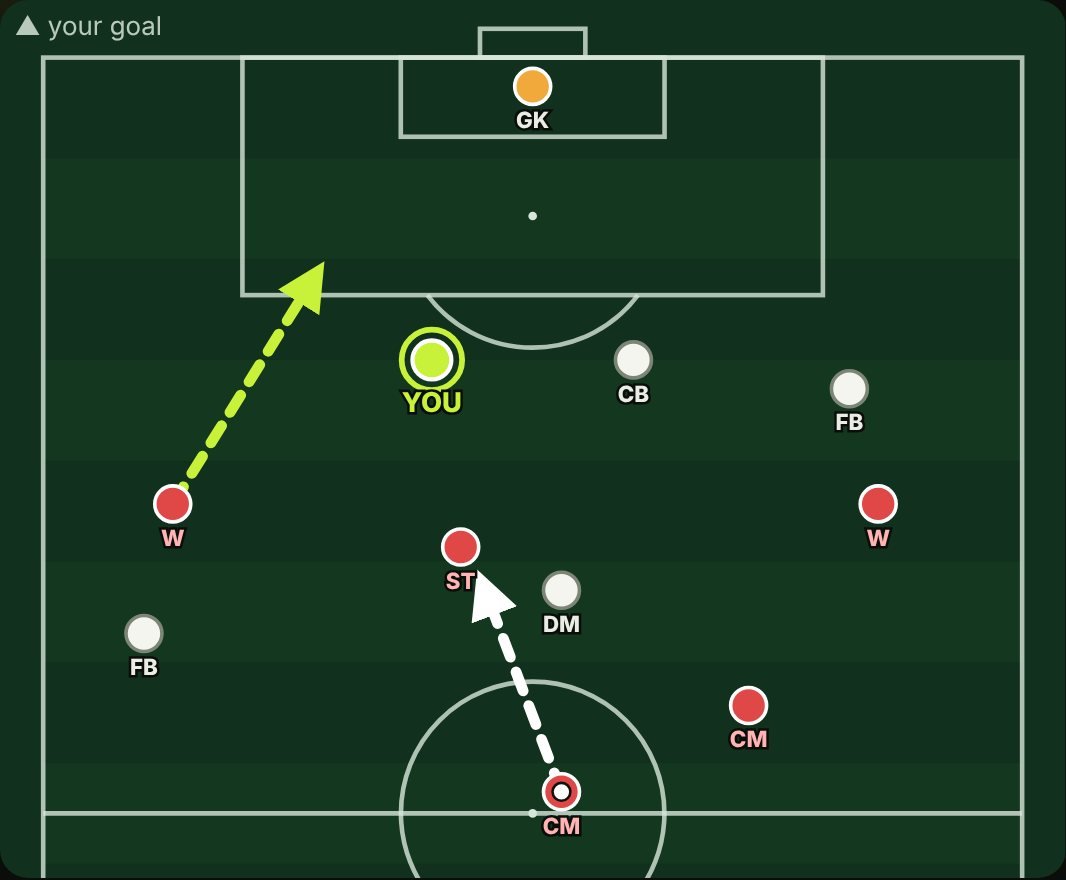
- A Follow him and get tight before he turns
- B Stay in the back line, shift across for the run, and let your midfielder press him (pro pick)
- C Drop deep towards your own box
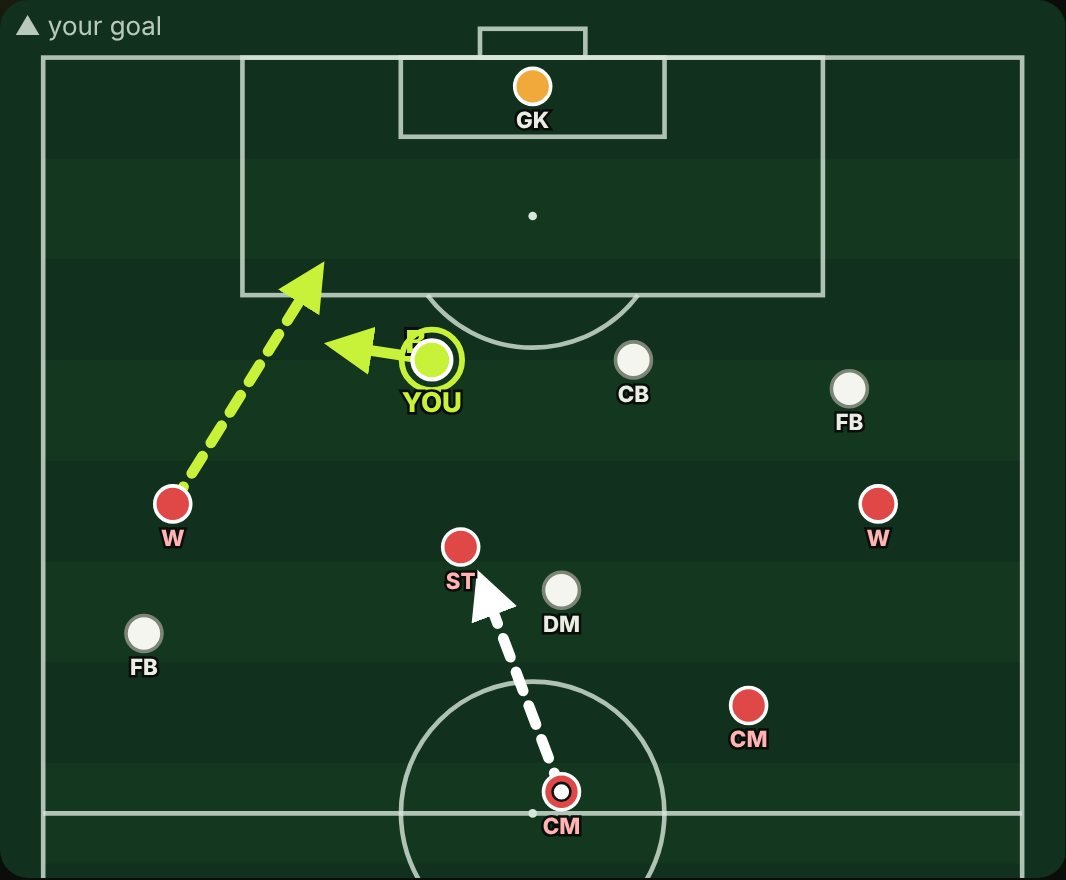
Why B is the pro pick: look at their winger. He’s running inside, straight into your channel, and your left back is too far up the pitch to track him. Their striker is facing his own goal, and your defensive midfielder is right next to him. So your midfielder presses the striker, and you shift across and pick up the run.
Why not A: following a striker who drops is often right: you stop him turning. But only when your cover is set. Here, the gap you’d leave is exactly where the winger is running.
Why not C: dropping deep gives their striker a free turn and lets him run at your back line. You only need to cover one run, not pull the whole line back.
The cue was the winger’s run and your left back’s position, not the striker. In most situations, the player on the ball isn’t the detail that decides it.
How to improve your result
Football IQ is trainable. The players who seem to “just see it” have usually seen these moments many times before. You can speed that up on your own:
- Watch one player, not the ball. Pick a pro in your position. Pause before he gets the ball, decide what you’d do, then press play and compare.
- Check your shoulder before every pass you receive in training, even when there’s no pressure. The decision starts before the ball arrives.
- Ask “what’s the score and the minute?” before risky decisions in games. Game state changes the answer more often than players think.
- Train your weakest skill on purpose. Spend a few weeks watching for that exact moment in games.
For full training plans, read our guides on football decision making training and soccer IQ training.
Want more than 8 situations?
Pause & Decide has 100 situations, 20 per position, in the same format as this test: a board, 3 options, the pro pick and why. It’s for training your decisions every week, not just checking them once.
FAQ
What is soccer IQ?
Soccer IQ (or football IQ) is how well you read the game and make decisions: seeing where the space and free players are, knowing what the score and minute ask for, and picking the best option quickly. It’s about decisions on the pitch, not football trivia.
Can you improve your football IQ?
Yes. Decision making improves with practice, like any other part of your game. Watching pros in your position with pauses, scanning more in training and reviewing your own decisions all help. Our soccer IQ training guide has a full plan.
Is a soccer IQ test accurate?
It’s a snapshot. 8 situations is enough to show which skills you get right and which you miss, but one guess can change your level. Use the result to find what to work on, and take it again later to see if the same gaps come up.
What’s the difference between football IQ and knowing football trivia?
Trivia tests what you know about football: results, rules, players. Football IQ is what you do in a game: reading a situation and choosing the right option under time pressure. You can know a lot of trivia and still make poor decisions on the pitch, and the other way round.
How long does it take to improve decision making?
There’s no fixed timeline, and it depends on how much you train it. Training it on purpose every week (watching pros with pauses, scanning in every session) helps more than waiting for it to come with games. Spotting the option on a screen comes first; making that decision in a real game, at speed, takes longer.